


What type of content is still worth creating when AI platforms can answer queries without sending a click?
AI answers are much more likely to fully satisfy the user’s need when they only want a quick explanation, and less likely when they still need proof, current or personalized data, a meaningful comparison, context specific guidance, or somewhere to complete the next action.
To translate this into something actionable that I can share with clients (and that I’ll share with you here), I’ve created a content prioritization framework in an AI search era, taking into account the reason a user would still visit the content, its proprietary value, and connection to business outcomes.
One of the most important inputs to the framework is the difference between AI traffic and AI citations. In my analysis of 40 leading sites across four verticals, AI referrals are just a fraction of organic search ones, and the pages receiving those referrals and those cited in AI answers are not always the same and serve different jobs.
A page can perform strongly in one layer and not in another. For example, a proprietary study may earn citations without generating much referral traffic, while a pricing, checkout or account page may receive valuable visits without being used as a cited source.
The criteria to prioritize your content
This is why it’s fundamental to assess click/traffic value, citation/mention value and business value independently, and then make sure that the three are aligned to provide the expected value to the brand.
The framework uses six directional dimensions that can be used to assess investment options, then reprioritize them with your site’s actual users, priority prompts, performance and business model:
Click resilience
This assesses how likely the user is to still need the site after seeing an AI answer. You can score it higher when a visit is required to interact, verify live details, inspect evidence, or complete an action; and score it lower when the interface can satisfy the need directly.
Citation potential
This assesses how likely the page is to provide unique, verifiable, primary or well-documented information that an AI platform, publisher, or another site may reference.
Brand mention potential
This assesses whether the content creates a relevant reason for the brand to be associated with an entity, topic, problem or need. A high score should come from the brand’s actual expertise, product, evidence or role within the content context.
Business value
This assesses how directly the content supports acquisition, conversion, retention, support or another defined outcome. The connection should follow a credible user journey, rather than the assumption that any traffic will eventually create commercial value.
Proprietary advantage
This assesses how difficult the content would be to reproduce without the organization’s data, access, expertise, systems, customer relationships or operating context.
Expected effort
This estimates the editorial, subject-matter, technical and maintenance resources required to produce the content, a high score means high cost. Live databases, original research and personalized tools can be valuable because they require more investment and are harder to reproduce, but their related costs need to be taken into account for a positive ROI.
Use the Content AI Search Prioritization Framework
I’ve used these criteria and content types into account in a downloadable worksheet you can use to assess your own content, which I’ll explain next.
The scores provide a directional starting point that you can adapt based on your audience, priority prompts, performance and business model.
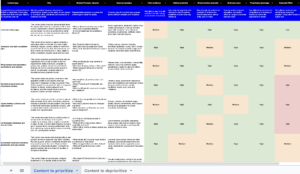
[Download or make a copy of the Content Prioritization Framework]
Let’s go through the framework recommended content to prioritize and deprioritize:
Recommended content to prioritize
Based on these six criteria, the content types worth prioritizing are those that continue to provide value beyond the AI answer: by establishing official facts, offering proprietary evidence or current data, supporting a meaningful decision, solving a context-specific need, or enabling the user to complete the next action.
However, it’s important to note that every content type has a different primary role and doesn’t need to generate clicks, citations and conversions at the same level.
Taking this into account, here are the content types with the strongest potential across one or more of these layers, with directional scores that should be adapted to your site’s actual performance, audience and business model.
1. Brand and entity pages
This content establishes the canonical facts about the organization: What it is and what it offers, who owns or represents it, where it operates and why it can be trusted. Its role is to provide entity clarity and verification, not detailed product instructions, live availability or conversion.
Related Prompts / Queries:
- What is [Brand] and what does it offer?
- Who owns or operates [Brand]?
- [Brand] legitimate and available in [Market]?
General Examples:
About, organization, leadership, author, trust, location and product or service overview pages with consistent facts, disclosed ownership or authorship, verifiable claims and a clear internal hierarchy.
Prioritization criteria:
- Click resilience: Medium
- Citation potential: High
- Brand mention potential: High
- Business value: High
- Proprietary advantage: High
- Expected Effort: Low
2. Transaction and task-completion pages
This content lets a person or agent complete a high-value action on the site: buy, book, apply, download, request, cancel, contact or resolve an account task. Its role is about the conversion, so it should show the current price or value, eligibility, safety constraints, required inputs and next step.
Related Prompts / Queries:
- Buy [Product] online in [Country]
- Book [Service] in [Location] for [Date]
- Start a trial, download [Product] or request a quote
General Examples:
Pricing, sign-up, checkout, booking, download, application, quote, claim, contact, account and support-resolution pages with complete, structured action requirements.
Prioritization criteria:
- Click resilience: High
- Citation potential: High
- Brand mention potential: Medium
- Business value: High
- Proprietary advantage: High
- Expected Effort: Medium
3. Official product documentation, specifications and policies
This content publishes authoritative facts only the organization can provide: product or service requirements, feature behavior, compatibility, pricing rules, policies, warranties and release changes. Its role is to be the current source of record, not persuade, compare options or troubleshoot every possible context.
Related Prompts / Queries:
- What are [Product]’s requirements or specifications?
- How does [Feature, Policy or Plan] work?
- What changed in [Product or Service] version [X]?
General Examples:
Release notes, documentation, compatibility matrices, policy and warranty pages, specifications, eligibility rules and official answers within maintained hubs.
Prioritization criteria:
- Click resilience: Medium
- Citation potential: High
- Brand mention potential: High
- Business value: High
- Proprietary advantage: High
- Expected Effort: Medium
4. First-hand product tests and performance reviews
This content tests one product or service under specified conditions and reports what was observed or measured. Its role is to answer ‘How did this specific option perform?’ with a transparent method, evidence, expert judgement and limitations, not infer market trends or prove a customer’s before and after outcome.
Related Prompts / Queries:
- How did [Product] perform under [Test condition]?
- Does [Product] work for [Specific use case]?
- What are [Product]’s measured strengths and limitations?
General Examples:
Hands-on tests, benchmarks, teardowns, trials, demonstrations and measured reviews documenting the method, sample, conditions, results, pros, cons and limitations.
Prioritization criteria:
- Click resilience: High
- Citation potential: High
- Brand mention potential: Medium
- Business value: High
- Proprietary advantage: High
- Expected Effort: High
5. Original market, audience and usage research
This content analyzes a product or service relevant dataset across many users, customers, products, markets or periods to reveal a pattern, benchmark or trend that hasn’t been previously covered., with a reproducible method, not review one item or explain one implementation.
Related Prompts / Queries:
- What is the average [Metric] for [Audience or Industry]?
- How has [Customer behavior] changed over time?
- Which [Features or Products] are most used by [Segment]?
General Examples:
Surveys, indexes, anonymized usage studies, industry benchmarks, trend reports and recurring datasets with a clear, repeatable methodology.
Prioritization criteria:
- Click resilience: Medium
- Citation potential: High
- Brand mention potential: High
- Business value: Medium
- Proprietary advantage: High
- Expected Effort: High
6. Live first-party databases and reference hubs
This content lets users look up current product or service facts that change, such as price, availability, inventory, status, eligibility, schedules or rates. Its role is current state reference across a set of relevant items; showing verified facts rather than calculating a personalized answer or creating one URL per keyword variation.
Related Prompts / Queries:
- Is [Product or Service] available in [Location] now?
- What are the current prices, rates or availability for [Item]?
- Which offers, events or status updates are active today?
General Examples:
Live inventories, availability databases, status pages, rate or price trackers, store locators, event calendars and frequently updated reference hubs.
Prioritization criteria:
- Click resilience: High
- Citation potential: High
- Brand mention potential: Medium
- Business value: High
- Proprietary advantage: High
- Expected Effort: High
7. Documented customer outcomes, experiments and case studies
This content documents what changed after a real product, service or approach was used, including the starting point, actions, constraints, timeline and measured outcome. Its role is ‘Show me that it worked in a comparable situation’, not teach the general process, test one product in isolation or compare alternatives.
Related Prompts / Queries:
- What results did [Customer type] achieve with [Product or Approach]?
- What changed before and after [Action]?
- What did [Experiment] show under [Condition]?
General Examples:
Customer case studies, before and after analyses, documented experiments and implementation stories supported by real inputs, screenshots, outputs and measurable results.
Prioritization criteria:
- Click resilience: High
- Citation potential: Medium
- Brand mention potential: Medium
- Business value: High
- Proprietary advantage: High
- Expected Effort: Medium
8. Product specific implementation and troubleshooting guides
This content helps an existing user configure, implement or fix a specific product when the correct steps depend on the version, device, environment, error, location or constraint. Its role is ‘Help me make it work here’, not proving a past outcome or choosing between products.
Related Prompts / Queries:
- Why doesn’t [Product] work on [Device or Version]?
- How do I configure [Feature] for [Use case or Constraint]?
- How do I resolve [Error] in [Specific environment]?
General Examples:
Troubleshooting trees, configuration guides, advanced implementation instructions and support content segmented by version, device, symptom, customer stage or operating environment.
Prioritization criteria:
- Click resilience: High
- Citation potential: Medium
- Brand mention potential: Medium
- Business value: High
- Proprietary advantage: High
- Expected Effort: Medium
9. Evidence led comparisons and selection guides
This content helps users to choose between two or more viable options for a defined scenario. Its role is to ‘Help me decide’ by applying transparent criteria, evidence and trade-offs, then explaining who each option is best for.
Related Prompts / Queries:
- [Product] vs [Alternative] for [Specific use case]
- Best [Category] for [Audience, budget or constraint]
- Which [Option] is right for [Specific need]?
General Examples:
X vs Y comparisons, alternatives pages, shortlists and best of guides with disclosed criteria, supporting evidence, limitations and scenarios in which different options win.
Prioritization criteria:
- Click resilience: Medium
- Citation potential: Low
- Brand mention potential: Medium
- Business value: High
- Proprietary advantage: Medium
- Expected Effort: Medium
10. Personalized tools using live or proprietary data
These are personalized tools using product or service data to help users solve needs related and complementary to the core ones provided by the brand products or services, with calculated, configured or recommended results. Its role is to produce a usable answer for this user or situation rather than simply display current facts or run a generic formula that an AI interface can reproduce.
Related Prompts / Queries:
- Calculate the total cost or ROI using my inputs
- Which plan or product fits my needs and current setup?
- Am I eligible for [Offer or Service] in my location or account?
General Examples:
Calculators, configurators, planners, recommenders, eligibility checkers and comparison tools driven by live, proprietary, account-level or user-specific inputs.
Prioritization criteria:
- Click resilience: High
- Citation potential: Low
- Brand mention potential: Low
- Business value: High
- Proprietary advantage: High
- Expected Effort: High
11. Curated community and practitioner knowledge
This content captures useful experience from customers, creators or practitioners, then adds authorship, moderation and editorial context. Its role is to featured real world know-how and edge cases, rather than the brand’s official answer or commissioned reporting as community evidence.
Related Prompts / Queries:
- How do experienced customers use [Product] for [Use case]?
- Which mistakes do practitioners recommend avoiding?
- What worked for organizations or people like mine?
General Examples:
Curated community Q&A, expert columns, creator hubs, customer showcases and moderated discussion archives with disclosed authorship and editorial context.
Prioritization criteria:
- Click resilience: Medium
- Citation potential: Medium
- Brand mention potential: Medium
- Business value: High
- Proprietary advantage: Medium
- Expected Effort: High
12. Original reporting and source analysis
This content is original reporting: interviews, event access, documents, observation or specialist analysis. Its role is to explain what happened and why using first-hand sources, not summarize another publisher’s report or turn a dataset into a market benchmark.
Related Prompts / Queries:
- Why did [Company or Industry] change [Product or Policy]?
- What did [Expert or Executive] reveal about [Topic]?
- What does [Recent development] mean for [Audience]?
General Examples:
Interviews, event coverage, investigations, expert analysis, behind the scenes reporting and original commentary supported by first-hand sources or media.
Prioritization criteria:
- Click resilience: High
- Citation potential: Medium
- Brand mention potential: High
- Business value: Medium
- Proprietary advantage: High
- Expected Effort: High
13. Scalable pages featuring genuine, useful insights powered by unique first-party data
This content provides a useful page for each real entity, product, location or integration because every page shows uniquely different owned data and serves a different task. Its role is scalable coverage of genuine, useful and relevant insights for the brand audience, not publishing keyword variants or templating public facts.
Related Prompts / Queries:
- [Product model] specifications, availability and change history
- [Location] service availability, prices and local requirements
- [Integration] setup, supported features and current status
General Examples:
Entity, product, location and integration pages featuring unique and useful metrics, availability, change history, comparisons and context from owned data, with editorial quality assurance.
Prioritization criteria:
- Click resilience: Medium
- Citation potential: High
- Brand mention potential: Medium
- Business value: High
- Proprietary advantage: High
- Expected Effort: High
Recommended content to deprioritize
At the other end of the framework are content types that AI answers are more likely to easily replace because they rely on widely available information, add little original value and/or have a weak connection to a meaningful user or business outcome. As you can see below, many times the problem isn’t necessarily with the format itself, but how it’s executed and whether it provides an actual reason to be visited, cited or associated with the brand.
It’s important to note in this case that deprioritizing these content types shouldn’t mean automatically deleting every existing page: Depending on its current performance and role, the right action might be to improve it with original value, consolidate it into a stronger, relevant page, or remove it while taking into account user experience and technical SEO best practices.
1. Standalone commodity definitions without brand or journey context
This content defines a common term or acronym using information already available everywhere. Search features and AI can answer it without a click; keep it only inside a relevant product, service or topic hub, or when the definition is genuinely brand specific.
Related Prompts / Queries:
- What is [Basic term]?
- What does [Acronym] mean?
- What is the difference between [Common term A] and [Common term B]?
General Examples:
Dictionary style definitions, basic explainers and acronym pages compiled from common knowledge with no distinctive brand, product, audience or next step context.
Prioritization criteria:
- Click resilience: Low
- Citation potential: Low
- Brand mention potential: Medium
- Business value: Low
- Proprietary advantage: Low
- Expected Effort: Low
2. Rehashed explainers and how to guides without original value
This content repackages common advice or existing sources without first-hand testing, expert contribution, original data, tools or distinctive media. Changing the length or title doesn’t fix the problem: AI can summarize the same consensus and the page gives users no extra reason to visit.
Related Prompts / Queries:
- How do I get started with [Broad topic]?
- Complete guide to [Common process]
- How can I improve [Generic outcome]?
General Examples:
Broad how-tos, expanded rewrites, exhaustive introductions and ‘everything you need to know’ guides assembled from public sources without original evidence or practical utility.
Prioritization criteria:
- Click resilience: Low
- Citation potential: Low
- Brand mention potential: Low
- Business value: Low
- Proprietary advantage: Low
- Expected Effort: Medium
3. Fragmented FAQ and keyword variant pages serving one intent
This content distribute one user need across different URLs because the questions or keywords are worded differently, not because the answer really changes. Consolidate them into the relevant canonical product, policy, support or transaction page unless a location, audience, regulation, platform or task creates a genuinely different answer.
Related Prompts / Queries:
- Is [Product] free? / Does [Product] cost anything?
- Buy [Product] online / Where can I order [Product]?
- Can I cancel [Plan]? / How do I end [Plan]?
General Examples:
Single question FAQ URLs and near duplicate pages created for wording, keyword or minor audience variations that a single, stronger canonical page can satisfy.
Prioritization criteria:
- Click resilience: Low
- Citation potential: Medium
- Brand mention potential: Low
- Business value: Low
- Proprietary advantage: Low
- Expected Effort: Low
4. Third-party news and press release rewrites without original input
This content repeats an announcement or another publisher’s reporting without adding a first-hand source, new evidence, analysis or audience specific impact. It becomes stale quickly and gives search or AI systems no reason to cite or send users to the rewrite.
Related Prompts / Queries:
- What did [Company] announce today?
- What changed in the latest [Third-party product] update?
- What is the latest news in [Industry]?
General Examples:
Press release rewrites, recaps copied from another source and summaries of third-party announcements with no original reporting, evidence or analysis.
Prioritization criteria:
- Click resilience: Low
- Citation potential: Low
- Brand mention potential: Low
- Business value: Low
- Proprietary advantage: Low
- Expected Effort: Medium
5. High volume tangential topics without a credible business journey
This content targets search demand that is only loosely related to the organization’s product, service, expertise or audience outcome. Even if it attracts visits, it has no credible next step or business value and is often fully satisfied by an AI answer.
Related Prompts / Queries:
- What are the biggest [Industry] trends in [Year]?
- How do I start [Unrelated activity]?
- What is the best [Unrelated product] for [Broad audience]?
General Examples:
High volume lifestyle, career, trend or industry topics that are only loosely related to the site and offer no useful next step.
Prioritization criteria:
- Click resilience: Low
- Citation potential: Low
- Brand mention potential: Low
- Business value: Low
- Proprietary advantage: Low
- Expected Effort: Medium
6. Biased or mass produced ‘best’, comparison and alternatives pages
This content targets purchase decision queries but doesn’t provide credible decision support: it ranks the publisher first, hides the method, repeats the same template at scale or cannot show a situation in which another option wins. Consolidate coverage and keep only comparisons with transparent criteria, evidence and meaningful trade-offs.
Related Prompts / Queries:
- What are the best [Category] brands?
- [Brand] vs [Competitor] for [Use case]
- What are the alternatives to [Product]?
General Examples:
Self-serving best-of lists, thin X vs. Y comparisons and alternatives pages created at scale without disclosed criteria, testing, evidence, trade-offs or audience-specific recommendations.
Prioritization criteria:
- Click resilience: Low
- Citation potential: Low
- Brand mention potential: Low
- Business value: Medium
- Proprietary advantage: Low
- Expected Effort: Medium
7. Generic calculators, quizzes and generators without distinctive inputs
This content applies a basic formula or produces a shallow answer from inputs an AI interface can handle directly. Keep it only when live or proprietary data, meaningful personalization, repeat use or a clear product action makes the output actually useful.
Related Prompts / Queries:
- Which [Product type] should I choose?
- Generate a [Topic] name
- Calculate a basic percentage or conversion
General Examples:
Generic quizzes, calculators and generators with no live data, personalization depth, recurring use, distinctive output or credible product journey.
Prioritization criteria:
- Click resilience: Low
- Citation potential: Low
- Brand mention potential: Low
- Business value: Low
- Proprietary advantage: Low
- Expected Effort: Medium
8. Programmatic pages built from public or competitor data
This content creates many templated pages from facts anyone can access, without unique first-party data, expert judgement or a genuinely different task on each URL. Scale multiplies duplication, maintenance and quality risks; it doesn’t create a real value.
Related Prompts / Queries:
- [Competitor] pricing and features
- [Third-party product] specifications
- [Generic term] glossary
General Examples:
Location, definition, specification, pricing or entity pages generated from third-party or public datasets without first-party data, expert judgement or a distinct user task.
Prioritization criteria:
- Click resilience: Low
- Citation potential: Low
- Brand mention potential: Low
- Business value: Low
- Proprietary advantage: Low
- Expected Effort: High
Wrapping up: Prioritize the content that still has a role after the AI answer
AI Search makes content prioritization much more important: When a user’s need can be fully satisfied with a summary of commonly available information, publishing another definition, generic guide or templated page is unlikely to generate meaningful, incremental value.
However, when the user still needs an official source, original evidence, current or personalized information, help making a decision, context specific guidance, or somewhere to complete an action, your site content continues to play a fundamental role.
The key question is what remains unresolved after the AI answer and whether your content is the best resource to satisfy that remaining need.
Use this framework as a directional starting point to assess each content type according to the role it plays for your audience and business, validating the scores with your actual search, AI visibility and conversion data, and revisit the prioritization as interfaces and user behavior continue to evolve.
Complementary AI search guides
- AI Search Is a 3rd-Party Citation Problem With an On-Page Corroboration Base: The Data Across SaaS, Ecommerce and Finance
- What It Takes for SaaS Brands to Win in AI Search
- The AI Search Optimization Checklist
- The 10 Key Characteristics of AI Search Winning Brands
- A 3-Layer Framework to Measure AI Presence, Readiness and Business Impact
- AI Traffic vs AI Citations
- How to Build a Representative AI Search Prompt Library
- 10-Market Patterns for Your Global AI Search Strategy
![The AI Search Optimization Checklist – With Worksheet [Updated Sep 2026]](https://www.aleydasolis.com/wp-content/themes/aleydasolis/imgs/flecha.svg)


