


AI search is largely a 3rd-party citation problem, supported by an on-page corroboration base: your site owned pages establish accurate, accessible facts while social, community, publisher, review, marketplace and competitor sources validate, demonstrate, compare or challenge them.
It’s then fundamental to establish a cross-functional operating framework: SEO coordinating with digital PR and social media to improve relevant earned and shared environments.
But is this true across different verticals and AI platforms? How much weight should we give to digital PR vs social? To assess it, I analyzed the top 10 cited source domains for 15 leading brands across SaaS, ecommerce and finance in Google AI Mode, Gemini and ChatGPT, using Semrush Enterprise data.
Every top source domain was assigned to one of the groups below:
- Owned: Domains controlled by the focal brand, its primary site and any owned subsidiary domains.
- Social / community / creator (Shared): Social, community and creator platforms. For example, YouTube, Reddit, LinkedIn, Facebook, Instagram, TikTok, Pinterest and Quora.
- News / review / comparison (Earned): Editorial publishers, specialist media and review or comparison platforms. For example, TechRadar, Forbes, Bankrate, NerdWallet, G2, Capterra and Trustpilot.
- Competitor (Earned): Domains of competing or substitutable brands in the same category. In ecommerce, this group is dominated by marketplace and retailer alternatives (for example Walmart, Target or eBay appearing within another retailer’s panel).
- Other third party (Earned): Remaining external references that don’t fit the above: General reference such as Wikipedia, search domains, and directories or vertical platforms not acting in a social/community role.
Let’s go through the findings and what they mean for your AI search optimization efforts.
1. AI search is primarily a 3rd-party citation problem
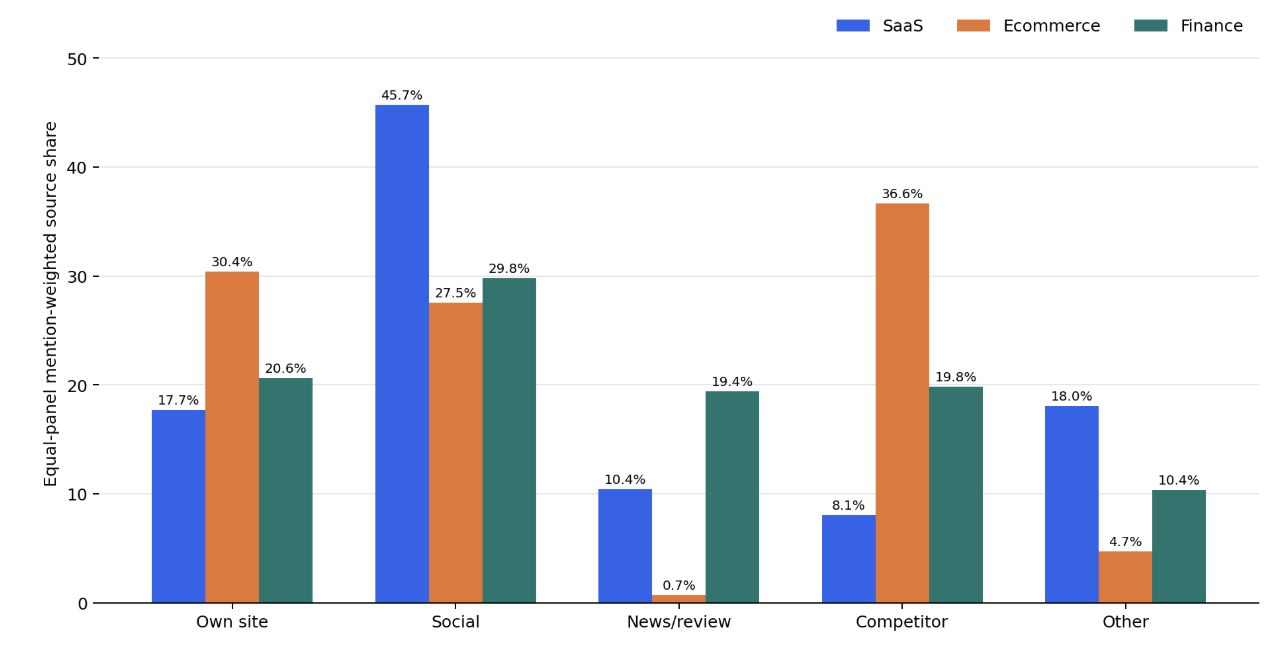
The most consistent finding is that the brand’s own website is a minority of the top cited source mix in every vertical. SaaS had the highest external share at 82.3%, followed by finance at 79.4% and ecommerce at 69.6%. Even ecommerce, the vertical with the strongest owned-site contribution still received more than two-thirds of its top cited-source mix from outside the brand’s controlled domain.
| Vertical | Owned | External | Social | News/review | Competitor |
|---|---|---|---|---|---|
| SaaS | 17.7% | 82.3% | 45.7% | 10.4% | 8.1% |
| Ecommerce | 30.4% | 69.6% | 27.5% | 0.7% | 36.6% |
| Finance | 20.6% | 79.4% | 29.8% | 19.4% | 19.8% |
This makes on-page SEO required for the corroboration base, providing the brand’s canonical facts, entities, product information, policies, documentation and first-party explanations that AI systems (and the third parties they cite) can verify, and third-party Web presence critical, since external sources add comparison, validation, experience, reputation and alternative viewpoints needed for a strong AI search visibility.
It’s also important to note how the brands’ own domains are mention-dense but slot-scarce: Across all three analyzed verticals they had only about 10-11% of the 150 top source slots, yet contributed a much larger share of the mentions weight, 20.6% in finance from just 10% of slots with similarly disproportionate shares in SaaS and ecommerce. This means that a brand’s own website can be influential when selected, but it’s only one part of the source.
These findings mean that you should:
- Treat third-party citation visibility as fundamental for AI search optimization, with budget and clear alignment with the relevant departments, not as an optional promotional layer after on-page optimization is finished.
- Analyze the sites influencing your targeted prompts before choosing digital PR or social targets.
- Measure your own source share and external corroboration independently. A rise in one shouldn’t automatically imply that a decline in the other is harmful.
- Keep your website canonical product, pricing, policy, documentation and support information relevant, up-to-date, accurate, so external sources have reliable material to reference and AI systems have a clear first-party source.
2. The weight of third-party AI citations shows how both social media and digital PR are needed, although their relative importance change by vertical and platform
Third-party AI citation sources differ by vertical and platform:
- SaaS is primarily social and community-led: Social/community domains account for 45.7% of the mention-weighted top cited-source mix, far ahead of news/review sources at 10.4% and competitor/alternative domains at 8.1%. YouTube had the largest share of citations among SaaS source domains, while Reddit appeared in every one of the 15 SaaS panels.
- Ecommerce is competitor and marketplace-led: Competitor, marketplace and retailer alternative domains account for 36.6%, with social/community sources at 27.5% and news/review sources at only 0.7%. This reflects how shopping answers frequently use retailer, marketplace and alternative product domains as commercial evidence. It doesn’t mean editorial authority is irrelevant to ecommerce overall; but that they’re almost absent from the top 10 cited sources.
- Finance has the strongest publisher, review and comparison citation sources: News/review sources account for 19.4%, above SaaS at 10.4% and ecommerce at 0.7%. Finance also has a meaningful competitor/alternative layer at 19.8%, but it’s concentrated around substitutable products, such as cards, payments, cross-border transfers, remittance and foreign exchange, rather than every company that sits somewhere in financial services.
The implications from an AI search optimization standpoint are that:
- For SaaS: You should prioritize video demonstrations, communities, practitioner discussion, reviews and specialist product ecosystems alongside owned documentation.
- For ecommerce: Audit the retailer, marketplace, alternative and comparison environments that influence product and brand answers, including where a competitor controls the cited page.
- For finance: Invest in accurate inclusion across specialist publishers, comparison sites, review and reputation sources, while strengthening transparent first-party content about fees, rates, eligibility, security and product constraints.
There are also differences in citations sources between AI platforms within the same verticals, which means that you will need to prioritize your efforts further based on the AI platforms used by your targeted audience:
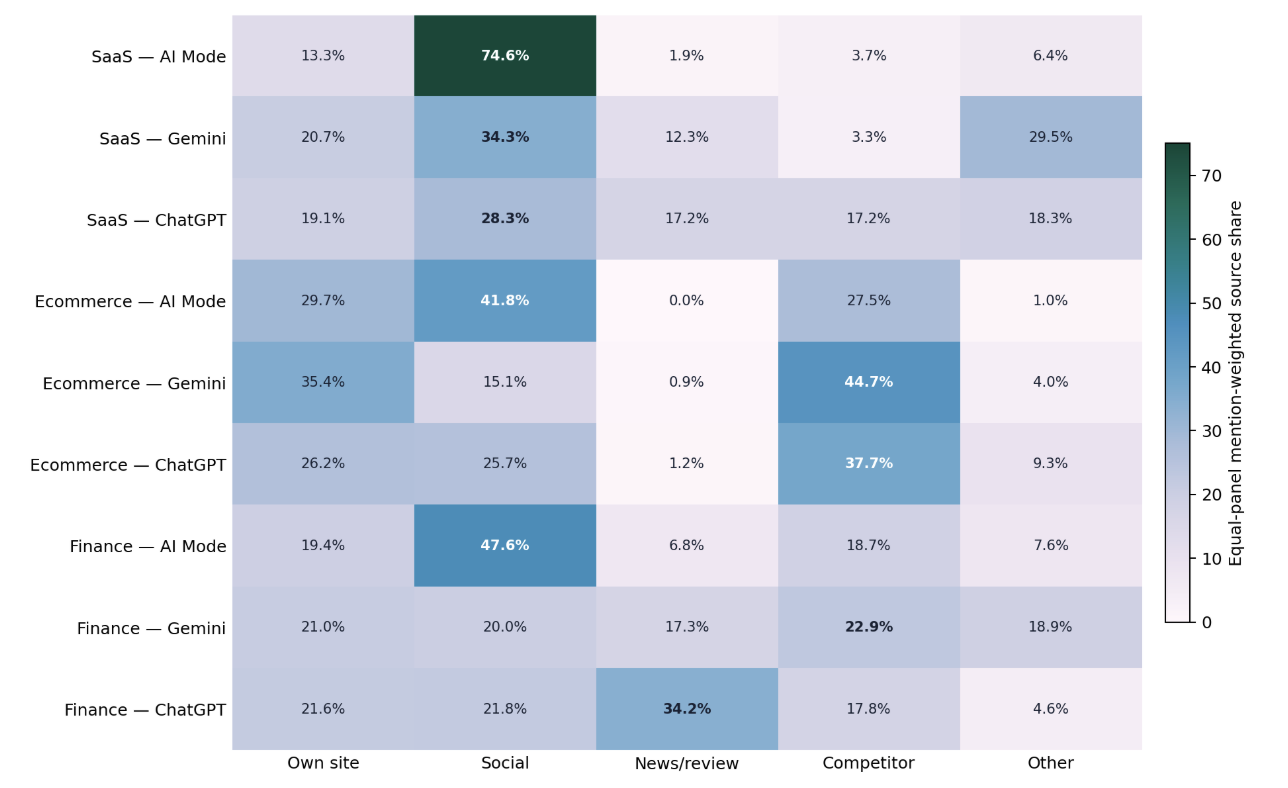
- AI Mode was the most social-led platform in all three verticals: This is extreme in SaaS, where social/community domains represented 74.6% of the mention-weighted top cited-source mix, but it was also imporant in ecommerce at 41.8% and finance at 47.6%.
- ChatGPT surfaced a more evaluative written layer: In finance, news/review sources rose to 34.2%; in ecommerce, competitor/alternative domains remained important at 37.7%; and in SaaS, the mix was comparatively distributed across social/community, news/review, competitor/alternative and other third-party sources.
- Gemini has a mixed citation source type: Ecommerce was strongly competitor- ed at 44.7%, finance was comparatively diversified, and SaaS still leaned most heavily on social sources.
| Vertical | AI Mode: largest group | Gemini: largest group | ChatGPT: largest group |
|---|---|---|---|
| SaaS | Social 74.6% | Social 34.3% | Social 28.3% |
| Ecommerce | Social 41.8% | Competitor 44.7% | Competitor 37.7% |
| Finance | Social 47.6% | Competitor 22.9% | News/review 34.2% |
The above findings mean that when establishing your third-party authority-building efforts, you should:
- Run citation source analysis separately for AI Mode, Gemini and ChatGPT, rather than blending them, to establish your visibility and citation gap in each.
- For AI Mode, you’ll likely need to create useful video, work with creator and community assets that genuinely demonstrate, explain or troubleshoot, not generic social posting volume.
- For ChatGPT, you’ll need to audit reusable written evidence: product and competitor comparisons, reviews, specialist publications, documentation and reputation sources.
- For Gemini, inspect the actual source distribution by category rather than assuming it behaves like either Google AI Mode or ChatGPT.
- Format and repurpose your brand assets to their evidence role: demonstrations as video, lived experience and troubleshooting through communities, validation through earned coverage, and canonical facts through owned pages.
3. An AI search visibility framework: owned evidence + earned corroboration + shared experience
To connect AI citations source categories with marketing ownership, I’ve mapped the benchmark to the PESO model at domain level:
- Owned: the focal brand’s controlled domains.
- Earned: news, review, comparison, competitor and other external authority sources.
- Shared: social, community and creator platforms.
- Paid: no source could be assigned to paid, because domain-level citation data cannot establish sponsorship, advertising, affiliate commission or promoted distribution. The column below is labeled “not observable” for that reason, it’s a limitation of the data, not evidence that paid activity is absent or irrelevant.
| Vertical | Owned | Earned | Shared | Paid (not observable) |
|---|---|---|---|---|
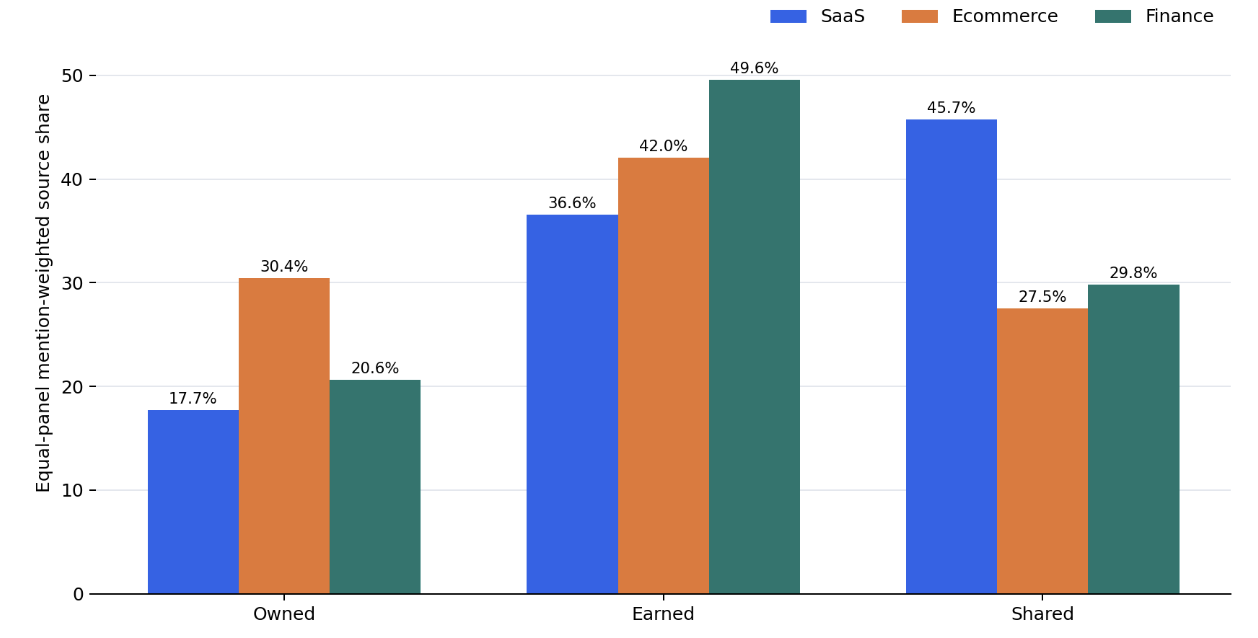
| SaaS | 17.7% | 36.6% | 45.7% | n/a |
| Ecommerce | 30.4% | 42.0% | 27.5% | n/a |
| Finance | 20.6% | 49.6% | 29.8% | n/a |
As can be seen above, none of the verticals is primarily “owned”. SaaS has the strongest shared media association at 45.7%; finance has the strongest earned media association at 49.6%; and ecommerce has the strongest owned contribution, but earned and shared combined still account for 69.6%.
The data shows on-page SEO, digital PR and social media need to work together for AI Search, and it’s fundamental to ask these questions:
- Which third-party environments influence the topics, prompts and platforms that are important to us?
- What on-page evidence can corroborate our brand claims?
- Which teams should strengthen each layer?
What AI search optimization practitioners say they are investing in
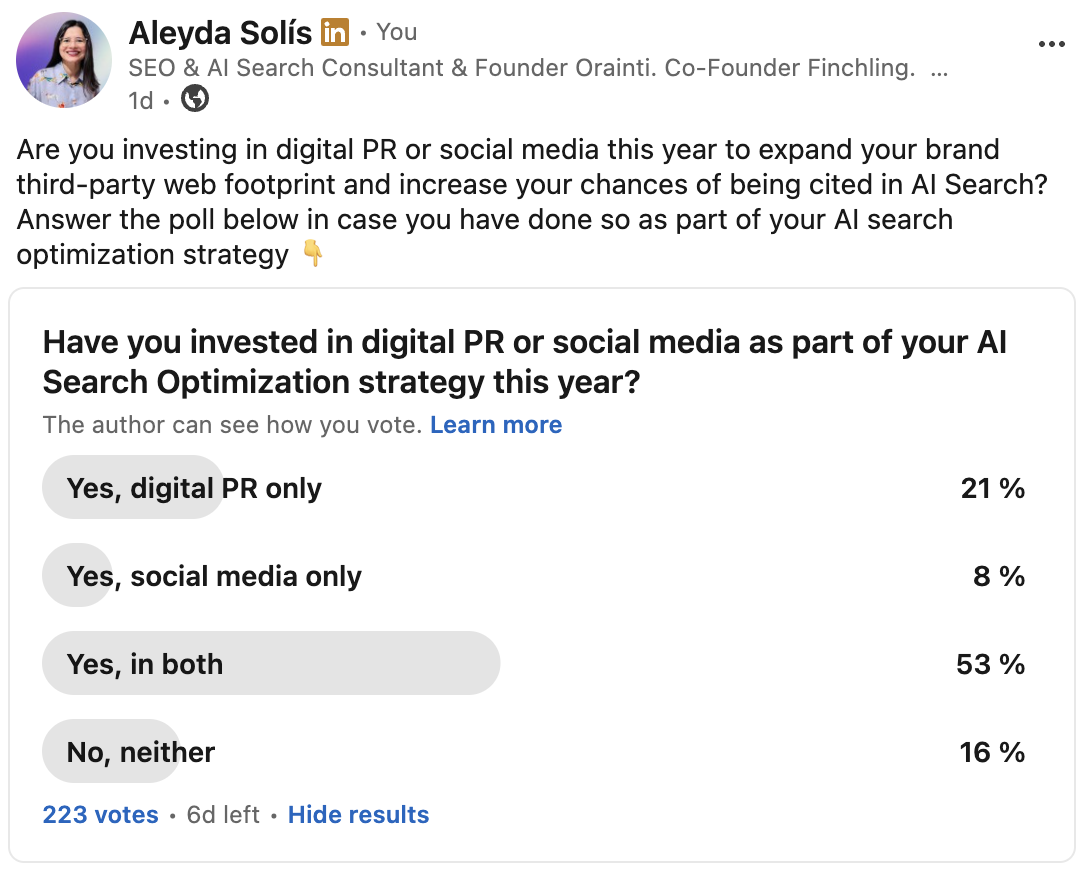
Are we already taking the above into account when optimizing for AI search? To assess this, I asked my LinkedIn followers: ‘Have you invested in digital PR or social media as part of your AI Search Optimization strategy this year?’ At the time captured, the poll showed 223 votes and still had one week remaining:
- 53%: Yes, in both.
- 21%: Yes, digital PR only.
- 8%: Yes, social media only.
- 16%: No, neither.
It shows that ‘both’ was the largest response among those who had voted, aligning with the operational implication of the citation research: earned and shared environments play different roles, and optimizing only one leaves an important part of the AI citation source ecosystem unattended.
Tips to create a winning AI corroboration loop
If you haven’t yet, to effectively align your AI search optimization efforts accordingly, you should:
- Create separate earned and shared workstreams: However, you should connect them via the same prompt library, source and brand representation priorities.
- Give digital PR a citation source brief: priority topics, claims requiring corroboration, high-leverage publishers, review/comparison gaps and the pages or assets that can support coverage.
- Give social and community teams an evidence-role brief: where demonstrations, user experience, troubleshooting, expert explanation and recurring misconceptions need stronger participation.
- Use paid media only as a possible amplifier and label it correctly. Don’t report a paid contribution to citations without campaign, disclosure or URL-level evidence.
It’s also important to take into account that a top cited domain isn’t automatically a target for outreach, and a citation isn’t automatically a business outcome. The value of a source depends on the role it plays in the answer and the action the user still needs to complete:
- A review platform may support alternative discovery.
- A specialist publisher may validate a financial claim.
- A competitor page may frame the comparison.
- Reddit may surface lived experience or objections.
- YouTube may demonstrate the workflow.
- The brand site may provide canonical specifications, policies or documentation.
Those roles require different actions, but they should reinforce one another:
- Correct and structure product facts on owned pages
- Give publishers verifiable data and expert access
- Keep review profiles accurate
- Participate authentically in relevant communities
- Publish demonstrations that resolve real user questions.
This creates a corroboration loop in which first-party facts and third-party evidence can be compared and validated. However, remember you can’t responsibly guarantee or buy an organic AI citation from any of them.
The source layer should therefore connect to the rest of the AI search journey. My research on AI traffic versus citations shows why: the page that supplies evidence is not always the destination that receives the measurable click. Citation visibility, recommendation, linked citation, referral traffic and business action should remain separate, connected KPIs.
A minimum viable First + Third Party Aligned AI search optimization Workflow
The findings above describe the evidence systems from leading brands. This is the sequence I recommend for turning them into an optimization program:
- Define the commercial prompts and journeys that matter. Start with representative prompt groups by product, market, persona, use case and decision stage.
- Capture the cited-source ecosystem by platform. Document domains, cited URLs, source type, brand presence, link presence and representation accuracy separately for AI Mode, Gemini and ChatGPT.
- Classify the evidence role. Separate owned facts, social/community experience, editorial/review validation, competitor framing, marketplaces and other reference sources.
- Identify the gap behind each weak prompt group. Is the problem missing owned evidence, absent third-party corroboration, inaccurate comparison, weak community presence, inaccessible content or unclear product/entity information?
- Prioritize by business importance and source leverage. Focus on sources repeatedly reused for high-value prompts rather than pursuing the broadest possible list of mentions.
- Strengthen the owned evidence core. Keep product, price, policy, specification, support and documentation content current, accessible, extractable and internally connected.
- Run distinct earned and shared programs. Coordinate with digital PR and expert outreach for verifiable coverage and comparison accuracy; use video, creator and community programs for demonstration and lived experience.
- Connect cited evidence to the next action. Make it easy to move from the cited or supporting asset to the appropriate commercial, transactional or support destination.
- Measure in layers. Track presence, recommendation, linked citation, source mix, representation accuracy, referrals and business outcomes without collapsing them into one visibility score.
- Validate repeatedly and report with confidence labels. Document the prompt set, platform, date, geography, source definitions and denominator, then distinguish observed results from directional interpretations and hypotheses.
| Owner | Primary responsibility |
|---|---|
| SEO / AI search | Prompt research, source diagnosis, owned-page accessibility, measurement and recurring validation. |
| Content | Canonical explanations, decision-support assets, documentation, comparisons, research and reusable evidence. |
| Digital PR | Publisher relationships, expert commentary, data led coverage, comparison accuracy and earned corroboration. |
| Social / community / creator | Demonstrations, expert participation, community support, social distribution and lived-experience signals. |
| Brand / product / legal | Positioning consistency, factual approval, claims, pricing, policy, risk and representation accuracy. |
| Analytics / BI | Source tracking, referral and conversion measurement, proxy signals and confidence labelled reporting. |
Wrapping-up
AI search can be understood as a third-party citation problem with an on-page corroboration base: Optimization can’t stop at the brand’s website, because the website is not the only place AI systems use to understand, validate and compare a brand, but reliable owned evidence is still needed for external claims and comparisons to confirm.
Across SaaS, ecommerce and finance, external domains accounted for 69.6% to 82.3% of the equal-panel, mention-weighted top cited-source mix, but the external system differed by vertical: social/community sources dominated SaaS; competitor and marketplace domains dominated ecommerce; and finance relied on a broader combination of publishers, reviews, comparisons, communities and product alternatives.
Each AI platform changes the citation mix again: AI Mode was consistently more social-led, while ChatGPT and Gemini surfaced different combinations of written evaluation, competitor and reference sources.
The defensible AI search strategy is then to build the on-page evidence base, then use source analysis to prioritize the relevant third-party environments: social and community proof for SaaS; marketplace, retailer and alternative product coverage for ecommerce; and specialist publisher, review, comparison and community corroboration for finance. This should be adapted again depending of the AI platform, whether is AI Mode, Gemini and ChatGPT, and validate the effect through repeated comparable samples.
This is how external authority becomes part of an AI search optimization process instead of another disconnected marketing campaign.
Complementary AI search guides
- Content Prioritization in an AI Search Era: A Framework + Worksheet
- What It Takes for SaaS Brands to Win in AI Search
- The AI Search Optimization Checklist
- The 10 Key Characteristics of AI Search Winning Brands
- A 3-Layer Framework to Measure AI Presence, Readiness and Business Impact
- AI Traffic vs AI Citations
- How to Build a Representative AI Search Prompt Library
- 10-Market Patterns for Your Global AI Search Strategy
![A 3 Layer Framework to Measure AI Search Presence, Readiness and Business Impact [Workbook + Examples]](https://www.aleydasolis.com/wp-content/themes/aleydasolis/imgs/flecha.svg)


