


Which third-party citations and platforms are actually worth investing in when the sources used by AI search platforms can change by vertical, prompt, market, platform and model release?
Although it’s easy to target third-party citation optimization with “one trick pony” tactics to “be active on Reddit” or “create more YouTube videos”, this doesn’t take into account why those platforms are cited, which prompts they influence, whether they’re relevant to the brand target audience, who should own the activity, and whether the work provides value beyond a current citation pattern that can change at any time.
My analysis of the most cited sources across SaaS, ecommerce and finance showed that external domains represented between 69.6% and 82.3% of the top cited source mix. However, the most influential external environments changed meaningfully by vertical and AI platform: social and community sources were particularly important for SaaS, marketplaces and competitor domains for ecommerce, and specialist publishers, reviews and comparison sources for finance.
This the reason why third-party citation optimization should be approached with proper alignment with other relevant marketing teams like digital PR or social media marketing that already lead the work on those platforms, have a roadmap and goals you can piggyback as well, taking into account the brand’s unique selling proposition, principles, editorial guidelines, etc. while avoiding an incorrect representation and lack of marketing or business impact, and scalable efforts that compound over time, which should be ultimately our goal.
To make this process easier to prioritize and coordinate, I’ve created a Third-Party Citation Prioritization Framework in an AI Search Era, with a worksheet assessing what to maximize, what to minimize, where each type of presence is usually developed, which marketing departments we should align with, and its expected influence, marketing and business value.
The criteria to prioritize third-party citation activity
The framework uses six directional dimensions to assess the prioritization of your third-party citation efforts: from their influence, to brand association potential, marketing alignment, business value, strategic durability and expected efforts.
The featured scores are starting points and should be personalized using your current visibility for your relevant target prompts (from a well represented AI search prompt library), actual citation sources, audience, market, vertical, marketing priorities and business model.
Citation influence
Citation influence assesses how strongly the third-party format can influence inclusion, recommendation, framing or supporting evidence in relevant AI answers.
A high score should be supported by repeated / consistent visibility across your key prompt groups or by a highly strong evidence role. It shouldn’t be based only on the authority or popularity of the domain.
Brand association potential
brand association potential assesses if the third-party presence creates a clear reason for the brand to be associated with a relevant category, problem, use case, audience or decision.
A passing mention might make the brand visible without establishing a meaningful association. A detailed review, expert contribution or customer outcome can connect the brand with a much more specific need.
Marketing alignment
Marketing alignment assesses how the activity supports and can be aligned with an existing marketing priority or workflow, such as digital PR, community management, creator marketing, reviews and reputation, marketplace management, partnerships or customer marketing.
Business value
Business value assesses how clearly the presence supports discovery, evaluation, acquisition, conversion, retention, reputation or another business outcome or goal. The connection should follow an established customer journey.
Strategic durability
Strategic durability assesses how likely the activity is to remain useful if an AI platform changes the sources it cites: Durable work should continue to provide audience, reputation, referral, relationship or commercial value even when the citation mix changes.
This is especially important because third-party source patterns can shift across AI platforms, markets and model releases.
Expected effort
Expected effort estimates the relationship, production, participation, data, review, technical and maintenance resources required for the third-party citation optimization activity, and a high score means a higher cost.
Some of the most valuable formats, such as first-hand product tests, research-led coverage or maintained marketplace ecosystems, are also expensive to earn and support. Their expected influence and business value should justify that investment.
Use the Third-Party Citation Prioritization Framework
I’ve included the citation types, platform environments, lead marketing functions, examples and directional scores in a downloadable worksheet you can adapt to your own business.
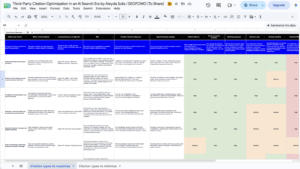
Download or make a copy of the Third-Party Citation Prioritization Framework.
Let’s go through the third-party citation types and formats the framework recommends maximizing and minimizing.
Third-party citation types and formats to maximize
The strongest third-party citation opportunities tend to provide something an AI answer and potential customer can use: independent evidence, a meaningful comparison, practical experience, current commercial information, specialist validation or proof of a real outcome.
However, each format has a different role. It doesn’t need to generate citations, brand association and direct business value at the same level to justify investment.
1. Independent first-hand reviews and tests
This coverage gives AI systems and customers independent evidence of how a product or service performs under defined conditions. It’s strongest when the reviewer shows the methodology, direct experience, strengths, limitations and relevant comparison points.
Where / relevant platform:
Specialist review and testing sites, trade publications, and creator or video platforms, especially YouTube.
Lead marketing area to align with:
Digital PR, creator or influencer marketing, and reviews or reputation.
Related prompts / decisions:
- Is [Brand or Product] good for [Specific use case]?
- How does [Product] perform under [Condition]?
- What are its main strengths and limitations?
Typical examples:
Hands-on publisher reviews, professional product tests, expert field trials, creator review videos and independently measured evaluations.
Prioritization criteria:
- Citation influence: High
- Brand association potential: High
- Marketing alignment: High
- Business value: High
- Strategic durability: High
- Expected effort: High
2. Evidence-led comparisons and recommendation shortlists
This format helps users understand how alternatives differ and which option fits a particular audience, budget, use case or constraint. Transparent criteria, current facts and meaningful trade-offs make the inclusion more credible and reusable.
Where / relevant platform:
Specialist comparison and review sites, buyer guide publishers, trade media, and relevant affiliate sites with disclosed methodology.
Lead marketing area to align with:
Digital PR, affiliate or partnership marketing, and reviews or reputation.
Related prompts / decisions:
- Best [Category] for [Audience or constraint]
- [Brand] vs [Competitor] for [Use case]
- What are the best alternatives to [Product]?
Typical examples:
Specialist comparisons, best of shortlists, alternatives guides, buyer guides and ranking tables with disclosed criteria and scenarios.
Prioritization criteria:
- Citation influence: High
- Brand association potential: High
- Marketing alignment: High
- Business value: High
- Strategic durability: Medium
- Expected effort: High
3. Practitioner demonstrations and task led tutorials
This format shows how a product, service or process works. A real demonstration, setup walkthrough or troubleshooting process provides visual or procedural evidence that a generic summary cannot fully replace.
Where / relevant platform:
Video platforms such as YouTube, specialist blogs and publications, creator sites, professional communities and webinar platforms.
Lead marketing area to align with:
Creator or influencer marketing, social or community, and product marketing.
Related prompts / decisions:
- How do I use [Product] for [Task]?
- How do I set up [Feature or Integration]?
- Can [Product] solve [Specific problem]?
Typical examples:
YouTube walkthroughs, specialist tutorials, creator demonstrations, webinars, implementation videos and step-by-step articles based on real use.
Prioritization criteria:
- Citation influence: High
- Brand association potential: High
- Marketing alignment: High
- Business value: High
- Strategic durability: High
- Effort (cost): High
4. Authentic community Q&A and troubleshooting discussions
Relevant community discussions provide lived experience, objections, edge cases and practical fixes that formal brand content often misses. They are valuable when participants answer real questions transparently, not when the brand inserts promotional mentions.
Where / relevant platform:
Reddit, specialist forums, public Q&A sites, professional communities, user groups and moderated support communities.
Lead marketing area to align with:
Community management, social media, and customer support or advocacy.
Related prompts / decisions:
- What do users think of [Brand] for [Use case]?
- How do I fix [Problem] with [Product]?
- What should I know before choosing [Brand]?
Typical examples:
Relevant Reddit threads, specialist forums, professional communities, public Q&A, user groups and moderated support discussions.
Prioritization criteria:
- Citation influence: High
- Brand association potential: High
- Marketing alignment: High
- Business value: Medium
- Strategic durability: Medium
- Effort (cost): High
5. Specialist editorial coverage and original reporting
Specialist coverage adds independent context, verification and category expertise. It’s most useful when the publication contributes reporting, analysis or evidence rather than repeating a company announcement.
Where / relevant platform:
Trade publications, specialist news sites, industry media and relevant local or vertical publishers.
Lead marketing area to align with:
Digital PR and corporate communications.
Related prompts / decisions:
- Why did [Brand] change [Product or Policy]?
- What does [Development] mean for [Audience]?
- Which companies are leading [Category or trend]?
Typical examples:
Specialist news stories, trade publication features, investigations, independently reported launches and category analysis.
Prioritization criteria:
- Citation influence: High
- Brand association potential: High
- Marketing alignment: High
- Business value: Medium
- Strategic durability: Medium
- Effort (cost): High
6. Expert commentary, interviews, podcasts and event coverage
This format associates the brand and its specialists with relevant expertise while adding first-hand interpretation. The strongest assets include specific insights, evidence or practical explanations that can also be quoted, cited or summarized in text.
Where / relevant platform:
Trade and specialist publications, podcast platforms, conference and event sites, expert roundups and professional media.
Lead marketing area to align with:
Digital PR, thought leadership and events.
Related prompts / decisions:
- What does [Expert] recommend for [Problem]?
- Why is [Industry change] happening?
- What did [Brand or Expert] reveal at [Event]?
Typical examples:
Quoted expert commentary, interviews, podcasts with transcripts, conference sessions, event recaps and expert roundups.
Prioritization criteria:
- Citation influence: Medium
- Brand association potential: High
- Marketing alignment: High
- Business value: Medium
- Strategic durability: Medium
- Effort (cost): Medium
7. Data-led articles and reports citing first-party research
This coverage turns owned research into independent corroboration. Clear methodology, accessible data and findings connected to a real industry or customer question make the brand easier to reference repeatedly.
Where / relevant platform:
Specialist publications, industry news and research sites, benchmark publishers and trade association sites.
Lead marketing area to align with:
Digital PR, research or content marketing, and corporate communications.
Related prompts / decisions:
- What is the average [Metric] for [Industry]?
- How is [Behavior or Market] changing?
- Which trends are supported by current data?
Typical examples:
Publisher analysis of brand research, industry reports, data stories, benchmark coverage and articles citing a clearly documented original study.
Prioritization criteria:
- Citation influence: High
- Brand association potential: High
- Marketing alignment: High
- Business value: Medium
- Strategic durability: High
- Effort (cost): High
8. Detailed customer reviews and maintained review profiles
Detailed reviews provide independent experience, recurring strengths and weaknesses, reputation context and decision support. Specific, genuine reviews are more useful than rating alone, while profiles need current product and company information.
Where / relevant platform:
Specialist review platforms, marketplaces and app stores, local review platforms and relevant reputation sites.
Lead marketing area to align with:
Reviews or reputation management and customer success.
Related prompts / decisions:
- Is [Brand] reliable and trustworthy?
- What do customers like or dislike about [Product]?
- Is [Product] suitable for [Customer type]?
Typical examples:
Detailed reviews and current profiles on specialist review sites, app stores, local platforms, marketplaces and relevant reputation services.
Prioritization criteria:
- Citation influence: High
- Brand association potential: High
- Marketing alignment: High
- Business value: High
- Strategic durability: High
- Effort (cost): High
9. Complete marketplace, retailer and reseller listings
This presence provides commercial evidence about specifications, price, availability, delivery, policies and merchant trust. It becomes especially important when an AI platform recommends the product but refers the eventual visit or purchase through a third-party seller.
Where / relevant platform:
Marketplaces, retailer product pages, reseller and distributor sites, shopping platforms and catalogs.
Lead marketing area to align with:
Ecommerce or marketplace teams and channel or retail marketing.
Related prompts / decisions:
- Where can I buy [Product] in [Market]?
- Is [Product] available now and at what price?
- Which seller offers [Requirement or delivery option]?
Typical examples:
Marketplace product pages, retailer and reseller listings, distributor catalogs and shopping profiles with consistent feeds, attributes and policies.
Prioritization criteria:
- Citation influence: High
- Brand association potential: High
- Marketing alignment: High
- Business value: High
- Strategic durability: High
- Effort (cost): High
10. Partner, integration and ecosystem documentation
This documentation provides third-party evidence of compatibility, implementation and shared use cases. Detailed joint documentation is more valuable than a logo page because it explains what works, for whom and how.
Where / relevant platform:
Partner and integration directories, app marketplaces, vendor documentation and partner solution pages.
Lead marketing area to align with:
Partnership or ecosystem marketing, product marketing and developer relations.
Related prompts / decisions:
- Does [Product] integrate or work with [Platform]?
- How do I implement [Brand] with [Tool]?
- Which partners support [Use case or market]?
Typical examples:
Integration directories, partner documentation, implementation guides, app marketplace pages, joint solution pages and verified partner profiles.
Prioritization criteria:
- Citation influence: Medium
- Brand association potential: High
- Marketing alignment: High
- Business value: High
- Strategic durability: High
- Effort (cost): Medium
11. Third-party case studies and customer stories
This format provides proof of what happened in a real environment through a customer, partner or publisher rather than only through the brand. It’s strongest when the starting point, actions, constraints and measurable outcome are clear.
Where / relevant platform:
Customer and partner sites, implementation partner sites, trade associations, and analyst or specialist publisher sites.
Lead marketing area to align with:
Customer marketing, digital PR and partnerships.
Related prompts / decisions:
- How did [Organization type] achieve [Outcome]?
- What results did customers get from [Product]?
- Does [Approach] work in [Specific environment]?
Typical examples:
Customer stories on partner sites, implementation case studies, analyst examples, association features and independently documented before and after results.
Prioritization criteria:
- Citation influence: Medium
- Brand association potential: High
- Marketing alignment: High
- Business value: High
- Strategic durability: High
- Effort (cost): High
12. Industry directories, credentials and local or vertical profiles
This presence confirms what the organization is, its offering, and if it has relevant credentials. Prioritize the platforms that support target entity, local or vertical prompts rather than maximizing directory count.
Where / relevant platform:
Trade association and accreditation sites, regulated provider directories, local business platforms, vertical directories and reference databases.
Lead marketing area to align with:
Local or vertical marketing, reputation and compliance.
Related prompts / decisions:
- Is [Brand] legitimate, licensed or certified?
- Does [Brand] operate in [Location]?
- Which providers offer [Service] in [Market]?
Typical examples:
Accreditation and association profiles, local business profiles, regulated-provider directories, vertical listings and authoritative entity or reference pages.
Prioritization criteria:
- Citation influence: Medium
- Brand association potential: High
- Marketing alignment: Medium
- Business value: Medium
- Strategic durability: High
- Effort (cost): Medium
13. Independent databases, benchmarks and ranking tables
This format provides structured comparative evidence that can be filtered, updated and reused across many decisions. It’s valuable when the methodology and data are credible and the brand’s inclusion is accurate and relevant.
Where / relevant platform:
Analyst and benchmark platforms, industry databases, public scorecards, standards sites, and ranking or data publishers.
Lead marketing area to align with:
Digital PR, analyst relations, and research or product marketing.
Related prompts / decisions:
- How does [Brand] compare on [Metric]?
- Which providers meet [Threshold or requirement]?
- What is the current ranking for [Category]?
Typical examples:
Industry benchmarks, product databases, public scorecards, analyst tables, standards databases and regularly updated comparison datasets.
Prioritization criteria:
- Citation influence: High
- Brand association potential: High
- Marketing alignment: Medium
- Business value: High
- Strategic durability: High
- Effort (cost): High
Third-party citation activity to minimize or avoid
At the other end of the framework are third-party activities that create little useful evidence, have low relevance or business value, depend too heavily on a current platform pattern, or introduce reputation and compliance risks.
Minimizing doesn’t always mean abandoning an existing presence: depending on its role and performance, the right action might be to improve it, consolidate the activity or stop investing in it.
The exception is deceptive activity such as fake reviews, astroturfing or undisclosed endorsements: this should be avoided completely.
1. Generic brand mentions with no clear evidence role
A passing mention may create superficial visibility, but it gives AI systems and potential customers little useful context for validating, comparing, recommending or understanding the brand.
Where / relevant platform:
Generic news or lifestyle sites, sponsor and event pages, logo walls and undifferentiated company lists.
Lead marketing area to align with:
Brand marketing and sponsorships.
Related prompts / decisions:
- Who sponsors [Event or List]?
- Which brands were briefly mentioned in [Article]?
- What companies appear on [Undifferentiated page]?
Typical examples:
Passing brand mentions, logo collections, sponsor thank yous and generic company lists with no explanation, evidence or relevant link.
Prioritization criteria:
- Citation influence: Low
- Brand association potential: Medium
- Marketing alignment: Low
- Business value: Low
- Strategic durability: Low
- Effort (cost): Low
2. Reach first coverage on irrelevant generalist sites
This activity prioritizes audience size or generic domain authority over topical and prompt relevance. A large publication isn’t automatically influential for the specific decision the brand needs to support.
Where / relevant platform:
National or general media, broad business publications, and sites with weak topical relevance.
Lead marketing area to align with:
Digital PR and corporate communications.
Related prompts / decisions:
- Broad lifestyle or business queries unrelated to the offer
- Generic trend coverage with only a passing brand reference
Typical examples:
High-reach articles and lifestyle or celebrity features disconnected from the target category, audience or market.
Prioritization criteria:
- Citation influence: Low
- Brand association potential: Medium
- Marketing alignment: Low
- Business value: Low
- Strategic durability: Low
- Effort (cost): High
3. Syndicated press releases and copied announcements
This format repeats the same company controlled message across many domains without adding independent reporting, analysis or experience. The domain count can increase without creating new corroboration.
Where / relevant platform:
Newswire networks, PR syndication sites, copied press-release pages and automated distribution portals.
Lead marketing area to align with:
Digital PR and corporate communications.
Related prompts / decisions:
- What did [Brand] announce?
- When did [Product or Partnership] launch?
Typical examples:
Newswire copies, automatically syndicated announcements, duplicated launch posts and lightly rewritten press-release coverage.
Prioritization criteria:
- Citation influence: Low
- Brand association potential: Medium
- Marketing alignment: Medium
- Business value: Low
- Strategic durability: Low
- Effort (cost): Medium
4. Thin best of listicles and paid inclusions without methodology
This format may name the brand, but it doesn’t explain why the option belongs in the list or how it compares. Undisclosed or criteria free inclusion provides weak decision support.
Where / relevant platform:
Low quality affiliate sites, pay to play ranking or listicle sites, and generic comparison directories.
Lead marketing area to align with:
Affiliate or partnership marketing and digital PR.
Related prompts / decisions:
- Best [Category] products
- Top [Number] providers
- Recommended [Category] brands
Typical examples:
Generic listicles, pay-to-play rankings, affiliate lists with copied descriptions and shortlists with no testing, criteria, trade-offs or disclosure.
Prioritization criteria:
- Citation influence: Low
- Brand association potential: Medium
- Marketing alignment: Low
- Business value: Medium
- Strategic durability: Low
- Effort (cost): Medium
5. Promotional guest posts or sponsored articles repeating brand claims
This content looks external but adds little independent evidence. Sponsorship can support distribution, but it shouldn’t be treated as proof that the source independently validates the claim or will influence organic AI citations.
Where / relevant platform:
Sponsored content or advertorial sections, generic guest-post sites and low-quality partner blogs.
Lead marketing area to align with:
Paid media, content partnerships and digital PR.
Related prompts / decisions:
- Why is [Brand] the best [Category]?
- What are the benefits of [Product]?
Typical examples:
Sponsored articles, advertorials, generic guest posts and partner posts that repeat marketing claims without useful testing, data, comparison or disclosure.
Prioritization criteria:
- Citation influence: Low
- Brand association potential: Medium
- Marketing alignment: Medium
- Business value: Low
- Strategic durability: Low
- Effort (cost): Medium
6. Generic social posts and short-form clips without demonstration
This format creates publishing volume but provides little durable evidence for a user decision. It becomes more useful when it shows a real workflow, answer, result or experience rather than only a slogan or trend format.
Where / relevant platform:
Short-form social and video platforms such as LinkedIn, TikTok, Instagram or YouTube Shorts when no useful demonstration is included.
Lead marketing area to align with:
Social media and creator or influencer marketing.
Related prompts / decisions:
- What is [Brand]?
- Generic product-awareness prompts
- Trend-led topics with no defined user question
Typical examples:
Promotional social updates, quote cards, generic short clips, recycled captions and trend participation with no practical explanation or proof.
Prioritization criteria:
- Citation influence: Low
- Brand association potential: Medium
- Marketing alignment: Medium
- Business value: Low
- Strategic durability: Low
- Effort (cost): Medium
7. Low-quality directory and profile creation
This activity treats listing volume as authority even when the platforms have no relevant audience, source influence or verification role. It also creates an avoidable maintenance and consistency burden.
Where / relevant platform:
Unmoderated directories, cloned business databases and irrelevant local or vertical listing sites.
Lead marketing area to align with:
Local or vertical marketing and reputation management.
Related prompts / decisions:
- Generic company or product directory queries
- Broad profile discovery unrelated to a target market or category
Typical examples:
Unmoderated directories, cloned profiles, irrelevant local listings, low-quality business databases and mass submission services.
Prioritization criteria:
- Citation influence: Low
- Brand association potential: Low
- Marketing alignment: Low
- Business value: Low
- Strategic durability: Low
- Effort (cost): Medium
8. Manufactured reviews, astroturfed discussions and undisclosed endorsements
This activity fabricates independent experience instead of earning it. It’s unethical, commonly breaches platform rules and creates serious legal and reputational risk. It should be avoided.
Where / relevant platform:
Avoid everywhere, especially review platforms, forums, communities, and social or creator channels.
Lead marketing area to align with:
Legal or compliance and reputation management for prevention and oversight, not execution.
Related prompts / decisions:
- Is [Brand] trustworthy?
- What do real users think of [Product]?
- Which product do community members recommend?
Typical examples:
Fake reviews, employee posts posing as customers, scripted community mentions, undisclosed paid endorsements and coordinated artificial sentiment.
Prioritization criteria:
- Citation influence: Low
- Brand association potential: Medium
- Marketing alignment: Low
- Business value: Low
- Strategic durability: Low
- Effort (cost): Medium
9. Stale or inconsistent third-party profiles and listings
This presence weakens corroboration when names, specifications, pricing, availability, policies or positioning conflict with the current owned source. Correct influential profiles rather than creating more unmanaged ones.
Where / relevant platform:
Review sites, marketplaces and retailers, directories and local platforms, app stores, partner sites and reseller pages.
Lead marketing area to align with:
Reviews or reputation, ecommerce or marketplace, and partnerships.
Related prompts / decisions:
- What does [Brand] offer now?
- Is [Product] available and at what price?
- Does [Brand] support [Feature or Market]?
Typical examples:
Abandoned review profiles, old marketplace listings, outdated directory entries, and inconsistent partner or reseller pages that no longer match the product.
Prioritization criteria:
- Citation influence: Low
- Brand association potential: Medium
- Marketing alignment: Low
- Business value: Low
- Strategic durability: Low
- Effort (cost): Medium
10. Single platform citation bait and mass replicated formats
This activity is built around the current prominence of one platform or source type rather than a durable audience or marketing need. Citation patterns can change between models, platforms, markets and releases.
Where / relevant platform:
Any currently prominent citation source or platform, such as Reddit or YouTube, when selected only for citation visibility, as well as mass publishing networks.
Lead marketing area to align with:
Social media, community and creator or influencer marketing.
Related prompts / decisions:
- Repetitive posts created only because one platform is currently cited
- Identical answers or videos targeting every keyword variation
Typical examples:
Mass produced Reddit style posts, copied Q&A, near identical videos, templated creator briefs and platform specific citation bait with no original value.
Prioritization criteria:
- Citation influence: Low
- Brand association potential: Medium
- Marketing alignment: Low
- Business value: Low
- Strategic durability: Low
- Effort (cost): High
11. Bulk AI-generated articles, reviews or videos with no original evidence
This format can reproduce existing information cheaply, but without first-hand experience, reliable sourcing, editorial oversight or distinctive evidence, it gives third parties and AI systems little reason to trust or reuse it.
Where / relevant platform:
Low quality guest post networks, faceless video or social channels, synthetic review sites, and mass-produced comparison or tutorial sites.
Lead marketing area to align with:
Content partnerships, social media and creator or influencer marketing.
Related prompts / decisions:
- Generic [Product] review
- Rewritten comparison or tutorial
- Summary of public facts already available elsewhere
Typical examples:
Automatically generated guest articles, synthetic reviews, faceless summary videos and large batches of rewritten comparison or tutorial content.
Prioritization criteria:
- Citation influence: Low
- Brand association potential: Low
- Marketing alignment: Low
- Business value: Low
- Strategic durability: Low
- Effort (cost): Low
Wrapping up: Build a durable, brand aligned third-party presence strategy, not a citation one trick pony
AI search optimization can’t stop on the brand’s own website, because AI platforms use third-party sources to compare, validate, demonstrate and challenge brand claims. However, this doesn’t mean the answer is to create a presence on every platform that happens to be frequently cited today.
The goal should be to identify the third-party web environments that influence your audience’s prompts topics and decisions through the customer journey, understand the evidence role they play, and align with the marketing functions that already have the expertise and relationships needed to improve them.
The most valuable activity should continue to help the audience and business even if an AI platform changes its citation mix: a useful product demonstration, accurate marketplace listing, trusted review profile, strong specialist relationship, helpful community answer or credible research study still has value across many channels.
Use this framework as a directional starting point. validate the scores with your own prompt library, citation, referral and business goals, adapt the platforms and owners to your organization, and revisit the prioritization as AI search platforms and user behavior continue to change.
Complementary AI search guides
- Content Prioritization in an AI Search Era: A Framework + Worksheet
- AI Search Is a 3rd-Party Citation Problem With an On-Page Corroboration Base: The Data Across SaaS, Ecommerce and Finance
- What It Takes for SaaS Brands to Win in AI Search
- The AI Search Optimization Checklist
- The 10 Key Characteristics of AI Search Winning Brands
- A 3-Layer Framework to Measure AI Presence, Readiness and Business Impact
- AI Traffic vs AI Citations
- How to Build a Representative AI Search Prompt Library
- 10-Market Patterns for Your Global AI Search Strategy
![The AI Search Optimization Framework & Checklist – With Worksheet [Updated Sep 2026]](https://www.aleydasolis.com/wp-content/themes/aleydasolis/imgs/flecha.svg)


