


There’s a tempting way to talk about AI search right now: AI traffic is growing, organic search is declining, and everything is shifting. It’s simple and dramatic but it’s not the most useful way to understand what’s actually happening.
To get a clearer view, I analyzed April 2026 USA Semrush data for the top sites by market share across four industries: Travel & Tourism, Finance, Real Estate and Shopping/Retail with 40 sites in total, 10 per vertical. The dataset includes site level traffic by channel, including Organic Search, AI Traffic and Google AI Mode, as well as top visited pages with channel split and a separate list of top pages cited in AI answers with prompt counts.
The first finding is straightforward: AI traffic is still tiny compared with organic search.
Across the 40 sites analyzed, organic search represents about 20.45% of visits, while AI traffic represents about 0.19%. So based on this data, AI traffic isn’t replacing traditional search traffic.
When comparing the pages receiving AI traffic with the pages cited in AI answers, a clearer pattern appears: AI traffic and AI citations reflect different layers of the AI search journey.
- AI traffic shows the measurable click endpoint: where users, or in some cases AI agents and assistants, land when a click happens.
- AI citations show a separate visibility layer: which URLs AI systems cite, surface or reference in answers, even when those pages don’t receive the click.
Those two layers overlap in some cases, but they don’t behave the same way: AI cited pages are much more distributed across discovery, evaluation, support, product, listing and informational surfaces. AI traffic, meanwhile, is much more concentrated on homepages, brand-entry pages, transactional pages, account/task flows and operational URLs.
AI referrals alone undercount AI’s influence on discovery, evaluation and recommendation. At the same time, AI citations should not be treated as proof that a URL was the factual source behind an answer. They’re a measurable citation and visibility signal, not the full AI visibility picture.
For SEOs, the practical implication is the need to separate AI presence, AI citations and AI referral traffic, and segment each by page type and journey stage: A homepage visit, a mortgage-rate citation, a product-page click, a support-page citation, a checkout visit and an OAuth redirect should not sit inside the same unqualified KPI.
The analysis below goes through the cross-vertical patterns, the differences by industry, where AI traffic and AI citations overlap or diverge, and what this changes in AI search optimization and reporting.
As with any third-party traffic and citation dataset, the numbers should be read directionally rather than as exact first-party analytics totals.
1. Organic search is still much bigger than AI traffic
Before looking at the citation layer, it’s important to ground the analysis in the traffic reality: AI traffic is still very small compared with organic search traffic across all four verticals.
Across the 40 sites analyzed, Semrush estimates organic search drives around 792.6M visits, while AI traffic drives around 7.36M visits.
In share terms, that means organic search represents about 20.45% of total visits, while AI traffic represents about 0.19%. In every vertical, organic search is a meaningful traffic channel, while AI traffic is still a very small share of total visits.
| Vertical | Organic share | AI traffic share | AI as % of organic | Google AI Mode as % of AI traffic |
|---|---|---|---|---|
| Real Estate | 29.70% | 0.14% | 0.48% | 4.8% |
| Shopping / Retail | 21.79% | 0.18% | 0.82% | 8.1% |
| Travel & Tourism | 21.43% | 0.12% | 0.57% | 10.1% |
| Finance | 12.53% | 0.26% | 2.08% | 2.3% |
Across the full 40 site sample, organic search traffic is roughly 108x larger than AI traffic. This is why it would be misleading to position AI referrals as a replacement for SEO traffic today.
The vertical differences are also useful:
- Real Estate is the most organic-search-led vertical in this sample, with organic search accounting for almost 30% of total visits. AI traffic, however, represents only 0.14% of visits and less than 0.5% of organic search traffic.
- Shopping/Retail and Travel show a similar organic search dependency, with organic search representing just over 21% of visits in both verticals. AI traffic remains small in both cases, but Google AI Mode represents a slightly higher share of AI traffic in Travel (10.1%) and Shopping/Retail (8.1%) than in Finance or Real Estate. That is worth monitoring separately as Google AI Mode becomes more visible in reporting and user behavior.
- Finance is the outlier on the surface: it has the lowest organic search share, at 12.53%, but the highest AI traffic share, at 0.26%. However, as explained later in the guide, this is heavily shaped by Stripe and task/workflow URLs. So the right takeaway isn’t simply “Finance gets more AI traffic.” It is that AI traffic composition matters as much as AI traffic volume.
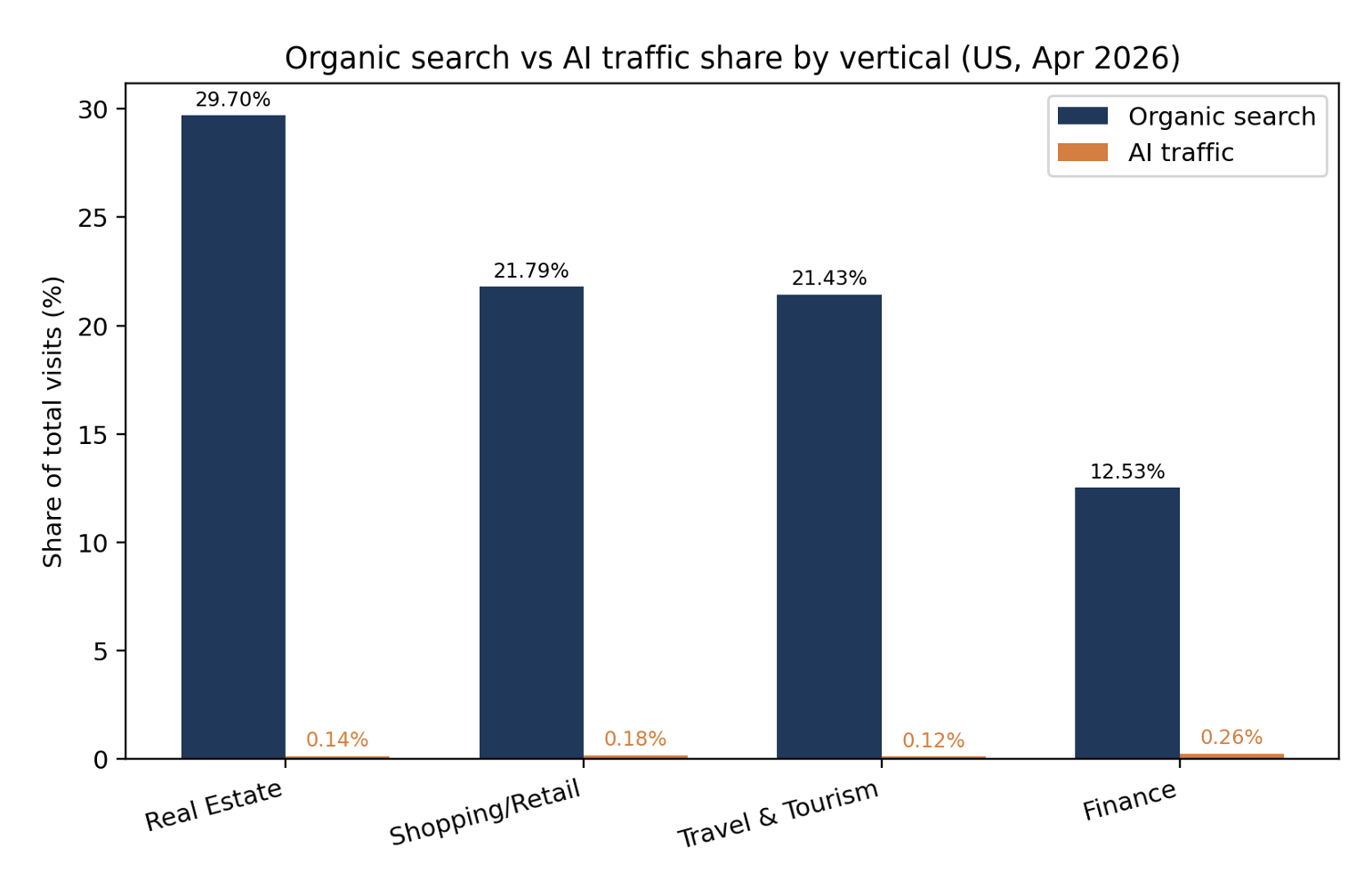
Chart 1. Organic search vs AI traffic share by vertical, April 2026 USA.
When comparing AI traffic vs organic search one, we see that it’s still below 1% of organic search traffic in Real Estate, Travel and Shopping/Retail. Finance is higher at 2.08%, but this needs the Stripe caveat discussed later.
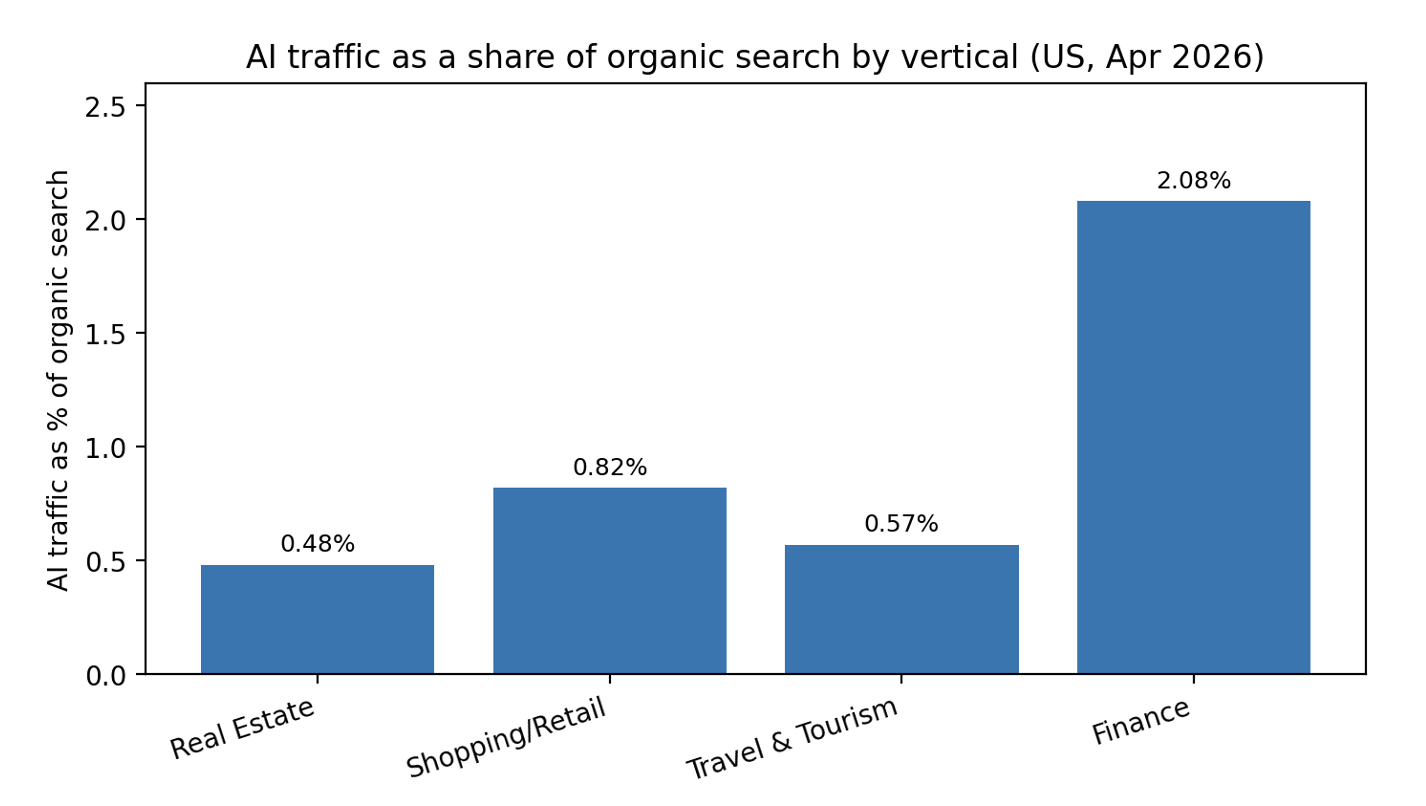
Chart 1B. AI traffic as a percentage of organic search traffic by vertical, April 2026 USA.
This matters for how we frame AI search performance. If we only look at traffic volume, the conclusion is straightforward: organic search is still the scale channel. It continues to drive far more measurable visits than AI traffic across these industries.
But even if AI traffic may be small, it can still show where AI journeys produce measurable referral clicks, and once we compare those clicked pages with the pages cited in AI answers, we start to see a more interesting split: AI citations show a broader visibility and evidence layer, while AI traffic often shows the measurable endpoint of the journey.
This is why the rest of this analysis doesn’t treat AI traffic as a replacement for organic search, but as one measurable layer of AI search visibility: useful, but incomplete on its own.
The more interesting question is not only how much AI traffic these sites receive, but whether the pages receiving AI traffic are the same pages AI systems cite, surface or reference in answers.
2. AI traffic and AI citations are not the same layer
The most important addition from the citation data is the ability to compare pages receiving AI traffic with pages cited in AI answers.
AI traffic shows where the measurable click lands. AI citations show which pages AI systems cite, reference or surface in answers. Although these two layers can overlap, but they shouldn’t be expected to behave the same way.
The key pattern found is that AI traffic is much more concentrated in brand-entry and action/task pages, while AI citations are much more distributed across discovery and evaluation pages.
| Journey layer | Share of AI traffic | Share of AI citations |
|---|---|---|
| Brand entry | 57.7% | 3.0% |
| Discovery / evaluation | 8.9% | 57.0% |
| Action / task / operational | 19.9% | 1.4% |
| Other deep / non-standard URL surfaces | 13.4% | 38.6% |
Brand-entry pages lead AI traffic, while discovery/evaluation pages lead AI citations: This is why AI referrals and AI-cited URLs need to be reported separately.
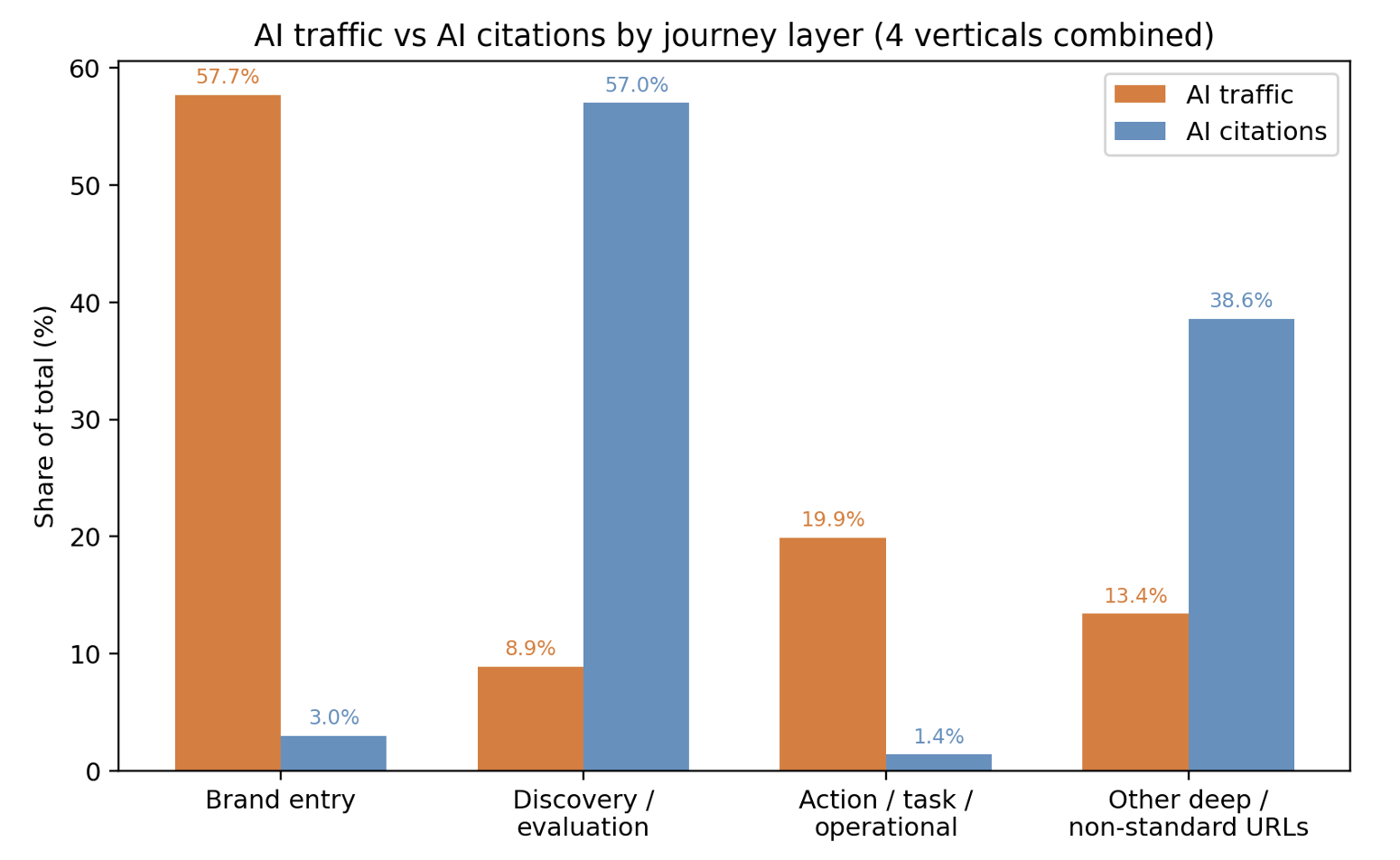
Chart 2. AI traffic vs AI citations by journey layer, 4 verticals combined.
Across the combined sample, about 57.7% of AI traffic in the top page sample goes to homepages or brand-entry pages, while only 3.0% of AI citations do. In contrast, discovery and evaluation pages account for about 57.0% of AI citations, but only 8.9% of AI traffic.
The “Other deep / non-standard URL surfaces” bucket is also large – 13.4% of AI traffic and 38.6% of citations, so it should not be treated as noise. It’s reviewed separately below.
3. Why AI traffic may land later in the journey and what else could be happening
A more transactional AI landing page mix isn’t necessarily surprising, it’s partly consistent with how AI search behaves:
In traditional search, users often click earlier in the journey: to compare options, read guides, browse categories, evaluate brands, check prices, understand features or validate trust signals across multiple pages.
In AI search, much of that discovery and evaluation can happen inside the answer itself. The AI system can summarize options, compare providers, narrow choices, explain differences, surface recommendations and help the user decide before a click happens. When the click finally happens, it may be more likely to go to the page that lets the user act: book the hotel, view the product, start the application, complete the payment, open the account, manage the trip, continue checkout, or access a retailer or marketplace page.
That “AI absorbs discovery, click happens later” explanation is consistent with the data, but it isn’t the only explanation. The pattern should be hedged appropriately:
- AI assistants may link more conservatively to brand homepages and product detail pages because these are safer, more canonical links and reduce the risk of stale or hallucinated references.
- AI systems often produce shorter answers with fewer links overall. When they do link, they may choose canonical entry points even if the user is still evaluating options.
- Citation data captures pages AI systems cite, mention or reference whether or not the user clicks. Traffic captures only the click. They’re not directly comparable as a perfect sequence.
- Some AI traffic may be driven by AI agents and assistants following workflow URLs, not by a human user making a classic marketing journey. Stripe is the clearest example in this dataset.
AI referral traffic likely underrepresents AI’s influence on discovery and evaluation, and may over represent later stage and brand entry pages, because of journey stage, answer format, link policy and workflow reasons.
4. What is in “Other deep / non-standard URL surfaces” and why it matters
The “Other deep / non-standard URL surfaces” bucket accounts for 13.4% of AI traffic and 38.6% of AI citations across the combined sample. That is too large to leave unexamined.
This bucket contains URLs that didn’t match any explicit pattern in the classification rule-set, not because they’re necessarily noise, but because they use non-standard URL structures that vary widely across sites and industries. Manual review of the top URLs shows it’s mostly composed of legitimate content surfaces:
| Sub-category | Example URLs | What they really are |
|---|---|---|
| Branded service subdomains | locators.bankofamerica.com; foreclosures.bankofamerica.com; locations.capitalone.com; business.cvs.com | Service, locator, business or specialty subdomains – effectively support/category content |
| Branded sub-roots and language variants | us.hotels.united.com; hilton.com/en; hilton.com/en/brands | Regional and language homepage variants and brand-portfolio pages |
| Real estate location and tool pages | zillow.com/ny; zillow.com/cambridge-ma; zillow.com/how-much-is-my-home-worth | Local discovery and home-value tools – effectively search/evaluation surfaces |
| Branded service/category pages with non-standard URLs | chase.com/digital/atms; walmart.com/cp/check-cashing; walgreens.com/topic/… | Service, category or topic pages without clean category URL prefixes |
| Travel destination and policy long-tail | expedia.com/lp/theme-vacations/all-inclusive-vacations; aa.com/i18n/travel-info/… | Editorial and policy content with bespoke URL structures |
| Pharmacy/retail service surfaces | cvs.com/pharmacy; photo.walgreens.com/store/prints; walgreens.com/offers/offers.jsp | Service and offer pages with retailer-specific URL patterns |
Most of what is in this bucket for citations is also discovery and evaluation content, it just uses URL structures that a simple rule-based classifier cannot cleanly bucket. If this bucket were manually redistributed, the discovery/evaluation share of citations would likely rise further. The directional pattern would be stronger, not weaker.
5. The strongest cross-vertical patterns
Before looking at each vertical individually, it’s useful to step back and identify the patterns that repeat across the full dataset.
Despite the differences between Travel, Finance, Real Estate and Shopping/Retail, the same broad behavior appears again and again: AI traffic tends to concentrate on brand-entry and action-oriented pages, while AI citations are much more distributed across the pages that help answer, validate, compare or support the user’s decision.
These cross-vertical patterns are the foundation for the more specific industry learnings that follow.
Pattern 1: Homepages are AI traffic sinks, but not the citation footprint
Across every vertical, homepages and brand entry pages receive a much higher share of AI traffic than AI citations. This is especially visible in Real Estate, but the pattern appears in all four verticals.
| Vertical | Homepage share of AI traffic | Homepage share of AI citations |
|---|---|---|
| Real Estate | 78.1% | 2.8% |
| Shopping/Retail | 57.6% | 4.9% |
| Finance | 53.9% | 0.9% |
| Travel & Tourism | 52.0% | 1.7% |
AI traffic concentrates on brand entry points; citations almost never do: that gap is the signal.
This supports the same interpretation in every vertical: AI systems may cite many supporting pages to answer, compare, validate or recommend, but the click often resolves to a brand entry point or action page. Travel and Shopping/Retail are close on homepage AI traffic share, but they’re not identical, the spread across verticals is real and worth tracking.
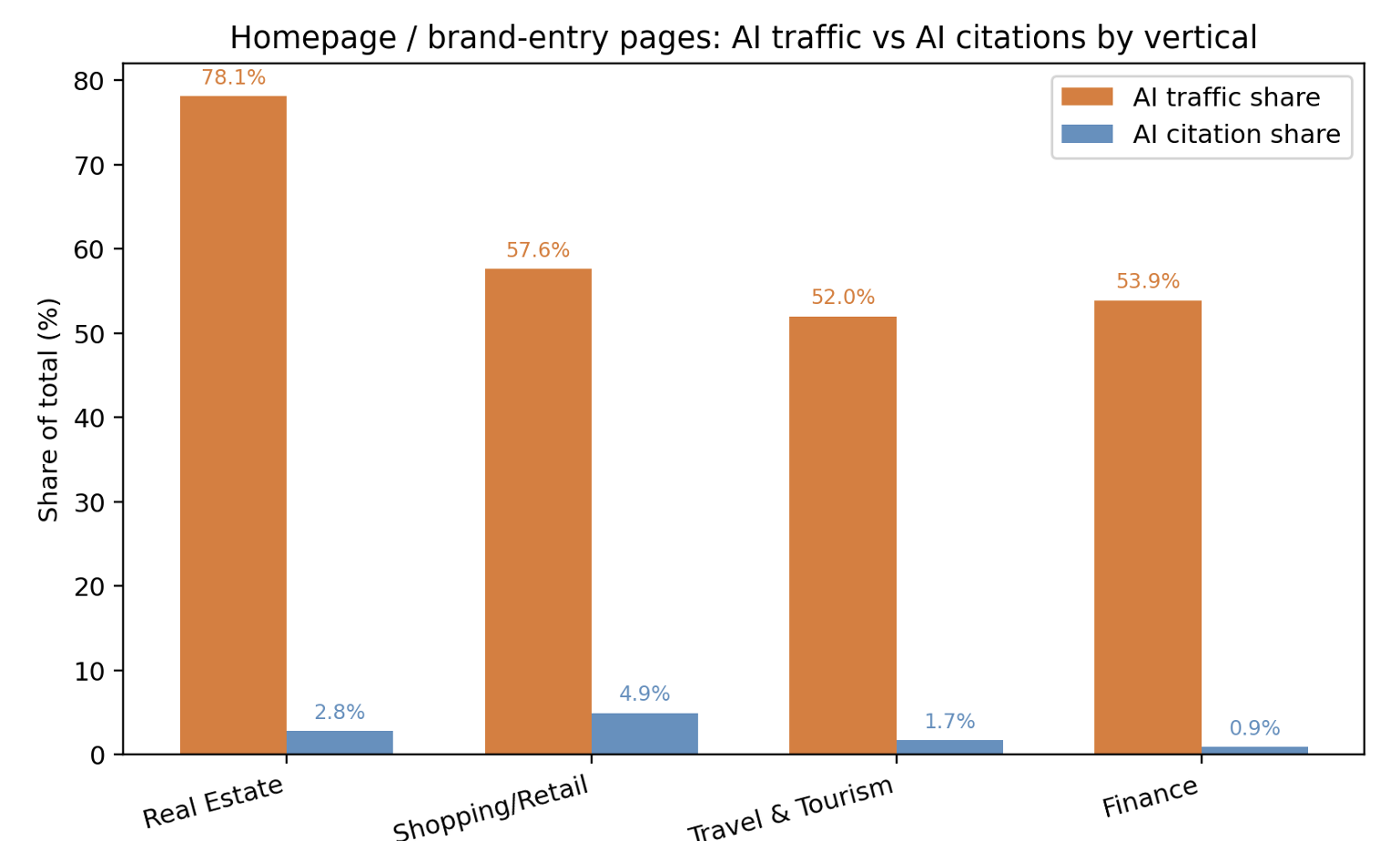
Chart 3. Homepage / brand-entry pages: AI traffic share vs AI citations share, by vertical.
Pattern 2: Citations are far more distributed than clicks
Comparing AI traffic pages with AI cited pages at the URL level reveals an asymmetric overlap: A large share of AI traffic in the top page sample lands on URLs that are also cited, often homepages and major commercial pages. However, only a small share of total citation prompts point to URLs that also receive measurable AI traffic in the top page sample.
| Vertical | AI traffic landing on cited pages | Cited prompts on AI-traffic pages |
|---|---|---|
| Real Estate | 86.6% | 3.2% |
| Travel & Tourism | 85.1% | 3.4% |
| Finance | 67.8% | 3.8% |
| Shopping/Retail | 67.6% | 6.7% |
The overlap is asymmetric: Many clicks land on cited URLs, but most citation activity is spread across a much broader URL inventory.
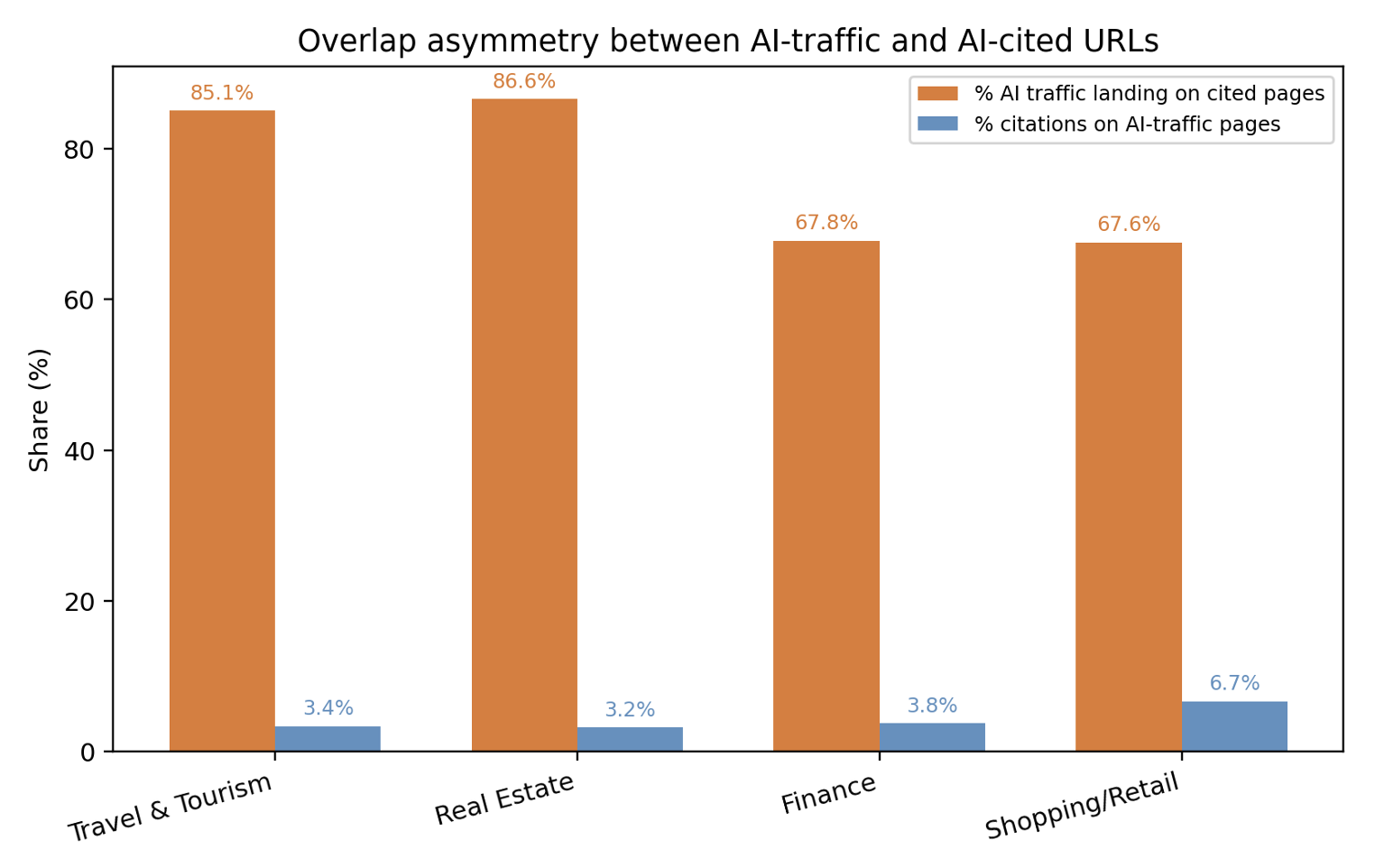
Chart 4. Overlap asymmetry between AI-traffic and AI-cited URLs, by vertical.
AI cited URLs are not simply a subset of AI traffic URLs. They’re a separate inventory that shows where AI systems cite, surface or reference information, even when those pages don’t receive the measurable click.
Pattern 3: AI cited pages look more like discovery and evaluation infrastructure
Across all four verticals, AI-cited pages are heavily weighted toward search/browse/category/listing pages, guide/editorial pages, support/help/policy/locator pages, and product/property detail pages.
| Page type | Share of AI traffic | Share of AI citations |
|---|---|---|
| Homepage / brand entry | 57.7% | 3.0% |
| Search / browse / category / listing | 4.5% | 28.3% |
| Guide / informational / editorial | 0.2% | 12.3% |
| Support / help / policy / locator | 1.2% | 10.1% |
| Product / listing / property detail | 2.9% | 6.2% |
| Account / app / cart / booking / checkout | 5.3% | 1.3% |
| Auth / operational / redirect | 14.6% | 0.1% |
| Other deep / non-standard URL surfaces | 13.4% | 38.6% |
The pages that help AI answers aren’t always the same pages receiving the click. This is why an AI search audit that only reviews AI referral landing pages misses much of the visibility layer. It’s also why AI search optimization cannot be reduced to the pages receiving AI traffic. If only the destination pages are analyzed, you miss many of the pages AI systems cite, surface or reference to generate, validate or support the answer.
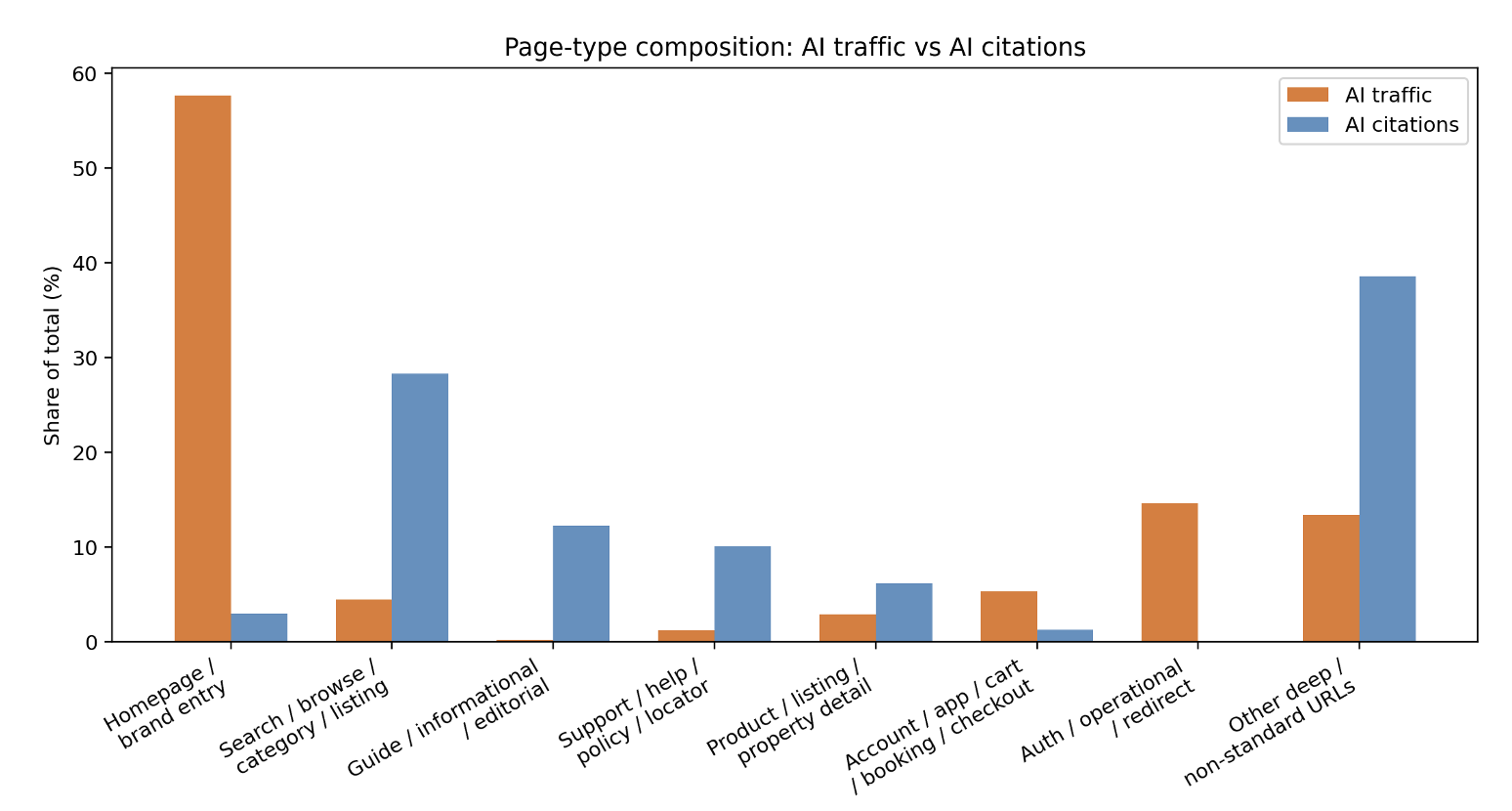
Chart 5. Page-type composition: AI traffic vs AI citations, 4 verticals combined.
Pattern 4: Stripe in Finance shows why citations and traffic measure different layers
One site in this dataset illustrates the traffic vs. citations distinction more clearly than any other: Stripe.
Stripe alone accounts for approximately 43% of all Finance AI traffic in this dataset: about 1.09M of the vertical’s 2.52M AI visits. Almost all of that traffic lands on dynamic, per-session or workflow URLs:
| Top Stripe AI traffic URLs | AI visits |
|---|---|
| dashboard.stripe.com/login | 9,107 |
| billing.stripe.com/p/login/… | 8,037 |
| stripe.com (homepage) | 6,016 |
| access.stripe.com/mcp/oauth2/authorize | 2,791 |
| marketplace.stripe.com/oauth/v2/authorize | 2,558 |
| checkout.stripe.com | 2,252 |
| status.stripe.com | 1,907 |
| billing.stripe.com/p/session/live_… | 1,080 |
| checkout.stripe.com/c/pay/cs_live_… | 1,080 |
Most of this looks like AI agents and assistants following links inside transactional workflows, OAuth flows, dashboard logins and per-session checkout/billing tokens, not consumers being recommended financial products.
By contrast, Stripe accounts for only about 7.3% of Finance AI citations, roughly proportionate to its 1-of-10 share of the vertical, and its cited URLs are mostly SMB finance education content from /resources/more/.
| Top Stripe AI-cited URLs | Citation prompts |
|---|---|
| stripe.com/resources/more/what-is-a-promo-code | 1,002 |
| stripe.com (homepage) | 663 |
| stripe.com/resources/more/ach-payments-101 | 533 |
| stripe.com/resources/more/how-to-check-if-a-business-name-is-taken | 438 |
| stripe.com/resources/more/swift-code-and-bic | 337 |
| stripe.com/payments | 324 |
| stripe.com/resources/more/llc-vs-inc… | 321 |
| stripe.com/resources/more/aba-routing-numbers-101… | 314 |
| stripe.com/resources/more/what-is-the-easiest-business-to-start | 274 |
| stripe.com/resources/more/how-to-register-a-business-in-the-us | 272 |
This is the citations vs. traffic thesis in a single site. Stripe’s AI traffic and AI citations have almost no URL overlap, and they measure completely different layers of AI search behavior: Workflow-internal link following on the traffic side, SMB-finance discovery and evaluation content on the citation side.
Without Stripe, Finance’s AI traffic share drops from 0.26% to roughly 0.155%, moving Finance from “highest AI share in the sample” to roughly tied with Shopping/Retail. The Stripe distortion doesn’t invalidate the patterns, but any “Finance leads on AI traffic” conclusion needs this disclosure attached.
6. SEO learnings from Vertical patterns
The cross-vertical patterns are useful, but they become much more actionable when interpreted by industry. The same “AI traffic vs AI citations” gap appears across all four verticals, but the reasons – and the SEO implications – change depending on the business model, user journey, page types, and who ultimately owns the click.
Travel, Finance, Real Estate and Shopping/Retail each show a different mix of cited pages, clicked pages, task flows, operational noise and commercial risk. Here’s what stands out by vertical:
Travel & Tourism
Travel is the clearest example of AI citations supporting planning and evaluation while AI traffic often moves closer to brand or booking surfaces.
In the AI traffic top page sample, around 52.0% of AI traffic goes to homepages/brand entries, about 9% to search/browse/category/listing pages, about 10% to product/property detail pages, and another large share to non-standard deep URLs such as regional homepage variants, brand sub-roots and editorial long-tail pages.
The AI-cited layer looks different: about 25% of cited prompts point to search/browse/category/listing pages, about 14% to product/property detail, about 6% to support/help/policy/locator pages such as baggage, check-in and travel info, and about 4% to guide/editorial pages – with another large non-standard URL share concentrated on branded subdomains and bespoke travel-info URLs.
Examples from the cited layer include Kayak flights/hotels pages, Expedia flights pages, Booking homepages, United flight-status and baggage pages, American Airlines carry-on/restricted/checked baggage pages, and Hilton brand and travel-info pages.
Travel AI search work shouldn’t only focus on destination guides. It should also cover flight/hotel search pages, baggage and policy pages, specific hotel/property pages, availability, pricing, amenities, booking paths, loyalty and account flows, and consistency across OTAs, hotel sites and travel platforms.
| Metric / layer | Travel & Tourism |
|---|---|
| AI traffic share of total visits | 0.12% |
| AI citations in discovery/evaluation pages | ~49% excluding non-standard deep URLs |
| AI traffic in brand-entry pages | 52.0% |
| AI traffic in action/task/operational pages | 4.7% |
| Citation density | ~156,000 prompts per site |
Finance
Finance is the vertical where the distinction between cited pages and traffic pages is most important, because the AI traffic layer is heavily shaped by task flows and by Stripe.
With Stripe included, Finance has the highest AI traffic share of the four verticals at 0.26% of total visits. Without Stripe, Finance’s AI share drops to roughly 0.155%, closer to Shopping/Retail.
The AI traffic layer is lead by brand and task pages: 53.9% homepage/brand entry, 8.3% account/app/cart/booking/checkout and 20.5% auth/operational/redirect pages.
The cited layer is very different: 28.3% guide/editorial, 24.7% search/browse/category/listing including mortgage rates, credit cards, loans, savings/CDs and balance transfers, and 13.8% support/help/policy/locator such as Zelle, ATMs, wire transfers and branch locators.
Examples include Wells Fargo and Bank of America mortgage rates, Fidelity learning-center articles, Chase routing numbers, Credit Karma loan and credit-card pages, and Bank of America locator/support pages.
Finance AI search reporting must separate discovery/evaluation from task completion and operational URLs. A referral to a payment approval page, dashboard or secure login path isn’t the same as a citation of a mortgage rate, credit card, tax, routing-number or investing guide page, and combining them produces misleading averages.
| Metric / layer | Finance |
|---|---|
| AI traffic share of total visits with Stripe | 0.26% |
| AI traffic share of total visits without Stripe | ~0.155% |
| AI citations in discovery/evaluation pages | 67.2% |
| AI traffic in brand-entry pages | 53.9% |
| AI traffic in action/task/operational pages | 28.8% |
| Citation density | ~108,000 prompts per site |
Real Estate
Real Estate remains the most organic-search-led vertical in this dataset, with 29.70% of total visits coming from organic search and only 0.14% from AI traffic.
The AI traffic layer is extremely homepage heavy: 78.1% of AI traffic in the top-page sample goes to brand entry pages. The cited layer shows something different: only 2.8% of AI citations point to homepages, while about 25% point to search/browse/category/listing pages, about 23% to guides/editorial content, and about 48% sits in the non-standard URL bucket, lead by city pages, agent search pages, neighborhood pages and home-value tools.
This matters because direct AI referrals don’t yet show a strong deep-listing discovery pattern, but cited pages suggest AI systems still cite and surface real-estate pages to answer broader housing, rental, agent, local, forecast and informational needs.
Examples include Realtor research/forecast and agent pages, Redfin rental/city/agent pages, Zillow learning content and home-value tools, Trulia rent pages and major portal homepages.
For Real Estate, direct AI traffic likely underrepresents the influence of AI answers more than in any other vertical analyzed here. The bigger opportunity is to monitor AI presence and citations for city, neighborhood, rental, homes-for-sale, agent, affordability and housing-market prompts, while keeping listing and local data clean, extractable and consistent.
| Metric / layer | Real Estate |
|---|---|
| AI traffic share of total visits | 0.14% |
| AI citations in discovery/evaluation pages | 48.9% excluding non-standard deep URLs |
| AI traffic in brand-entry pages | 78.1% |
| AI traffic in action/task/operational pages | 0.4% |
| Citation density | ~123,000 prompts per site |
Shopping/Retail
Shopping/Retail has the largest absolute AI traffic volume in the sample: about 3.7M AI visits – and the largest citation density, at about 243K prompts per site.
AI traffic is lead by brand entry and operational/task paths: 57.6% homepage/brand entry, 14.7% auth/operational/redirect and 4.4% account/app/cart/checkout. Temu’s app/campaign redirect URL and eBay challenge URLs are examples of why operational filtering matters: they can move percentages by several points on their own.
The AI cited layer looks much more like ecommerce discovery and evaluation infrastructure: 33.4% search/browse/category/listing, 16.2% support/help/policy/locator such as store-locator, MinuteClinic and services pages, 7.0% product/listing/detail, 5.2% guide/editorial and 4.9% homepage.
Examples from the cited layer include Walmart, eBay, Etsy, Target, Home Depot and Lowe’s commercial surfaces; CVS and Walgreens store/service locator pages; and editorial/topic pages for Samsung and other retailers.
Ecommerce AI search optimization cannot be reduced to content around products, but it also cannot ignore product data. AI systems need product feeds, PDPs, category pages, reviews, prices, availability, specs, delivery, returns, merchant trust and marketplace/reseller representation to support commercial answers.
Ecommerce brands also face a specific risk: AI can recommend a product or brand and route the click to Amazon, Walmart, eBay, Etsy, Target, Home Depot, Lowe’s, CVS, Walgreens, a marketplace or a reseller instead of the brand’s owned site.
| Metric / layer | Shopping/Retail |
|---|---|
| AI traffic share of total visits | 0.18% |
| AI citations in discovery/evaluation pages | 61.7% |
| AI traffic in brand-entry pages | 57.6% |
| AI traffic in action/task/operational pages | 19.1% |
| Citation density | ~243,000 prompts per site |
Shopping/Retail isn’t only the largest vertical by AI traffic; it’s also where AI systems cite the most pages per site: about 2.3x the citation density of Finance and about 2x that of Real Estate. This is consistent with ecommerce queries triggering more AI evaluation work per answer.
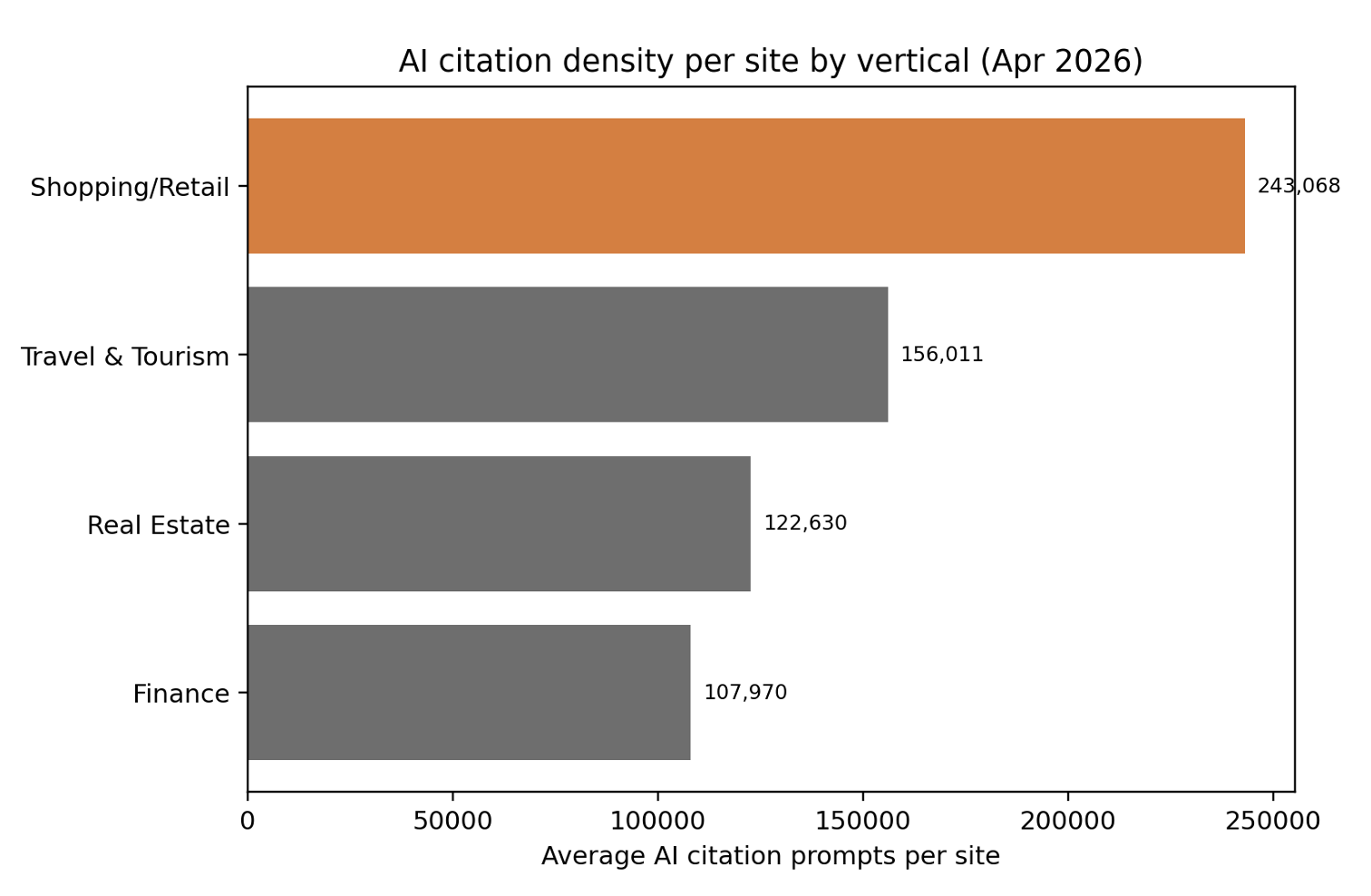
Chart 6. AI citation density per site by vertical, April 2026 USA.
7. How SEOs and marketers can report this
The practical mistake would be to create one blended “AI search traffic” metric and treat it as the whole AI search story. The patterns above show that AI search reporting needs to separate different layers that are often connected, but don’t measure the same thing.
AI presence tells you whether the brand appears in relevant answers. AI citations show which URLs AI systems cite, surface or reference. AI traffic shows where the measurable referral click lands. Page type, traffic owner and business impact then help explain what those signals actually mean.
This is important because the pages cited in AI answers are often not the same pages receiving AI traffic. A guide, category page, locator page, product page or mortgage-rate page might help support the answer, while the click goes to a homepage, checkout flow, booking page, retailer page, account URL, OAuth redirect or app surface.
That means the reporting question shouldn’t only be: “How much AI traffic did we get?” It should be: “Where are we present, which pages are cited, where do clicks land, what type of page is each URL, and who captures the value?”.
| Layer | What to measure | Why it matters |
|---|---|---|
| AI presence | Whether the brand appears in relevant AI answers | Captures visibility even without clicks. |
| AI citations | Which URLs are cited, referenced or surfaced | Shows the URLs/pages AI systems cite, surface or reference for discovery, validation and evidence. |
| AI traffic | Which URLs receive clicks from AI sources | Shows the measurable referral endpoint. |
| Page type | Homepage, category, product, guide, support, account, checkout, auth/redirect | Prevents misleading conclusions from blended URLs. |
| Traffic owner | Owned site, marketplace, retailer, portal, app flow, third-party platform | Shows who captures the customer relationship and commercial value. |
| Business impact | Observed conversions, assisted demand, branded search lift, direct traffic lift, cited-page performance | Connects visibility to value while separating observed, proxy and modelled signals. |
This layered view prevents the most common reporting mistake: treating all AI-related signals as if they represented the same user behavior.
For example, an AI citation of a finance guide doesn’t mean the same thing as an AI referral to a secure login page. A product-page click doesn’t mean the same thing as a support-page citation. A marketplace click doesn’t mean the same thing as a click to the brand’s owned site. Each one can be valuable, but each one answers a different question.
The second step is to segment both AI cited pages and AI traffic pages by page type. This is where the analysis becomes actionable, because it helps separate visibility, evaluation, task completion and operational noise.
| Bucket | Examples | Interpretation |
|---|---|---|
| Brand entry | Homepage, root domain, major brand landing pages | AI sends the user to the brand, but not necessarily to the exact page that supported the answer. |
| Discovery / evaluation | Search, category, listing, product, guide, support, policy, locator pages | AI cites these pages to answer, compare, validate and recommend. |
| Action / task | Cart, checkout, booking, application, payment, account, trip/order management | The click happens when the user is ready to act or continue a task. |
| Operational / noise | OAuth, login, redirects, challenge, verification, secure auth, app-redirect URLs | Important to filter before drawing marketing conclusions. |
| Other deep / non-standard URL surfaces | Branded subdomains, regional roots, bespoke topic URLs | Often discovery/evaluation in disguise – needs manual review. |
This segmentation is what keeps AI search reporting relevance: A spike in AI traffic to checkout, login, app-redirect or OAuth URLs should not automatically be interpreted as improved AI search discovery. It might reflect task continuation, agent workflows, app behavior or operational link-following.
At the same time, a cited page with little or no AI referral traffic should not be dismissed as low value: It might be part of the visibility and evidence layer that helps the brand appear, be understood, be compared or be recommended in AI answers.
This is especially important in verticals where the click owner and the brand being evaluated are not always the same. In ecommerce, travel and marketplaces, AI can create or influence demand for a brand while routing the click to a retailer, OTA, marketplace, reseller, portal or competitor-owned surface. In that scenario, traffic volume alone won’t show who benefited from the visibility.
8. What this changes in AI search optimization
AI search optimization can’t be managed from referral traffic alone: AI traffic shows the measurable click endpoint and AI citations show part of the visibility and evidence layer, all this taking into account that Organic search still shows the larger demand and discovery channel.
If the pages AI systems cite are often different from the pages receiving AI traffic, then the optimization work also needs to be split: improve the pages that help AI systems answer, validate and recommend, while also making sure the pages receiving the click are ready to convert, support the task, and preserve traffic ownership.
That changes the way AI search should be analyzed, reported and optimized:
Don’t judge AI search performance only from AI referrals.
AI referrals are the measurable click layer, but they undercount AI’s influence on discovery, evaluation and recommendation.
Analyze cited pages and traffic pages separately.
Cited pages show what AI systems cite, reference or surface as evidence. Traffic pages show where users or AI agents end up when a click happens. They answer different questions.
Segment by page type before making strategic claims.
A homepage visit, checkout click, product-page visit, mortgage-rate citation and OAuth redirect should not sit inside the same unqualified KPI.
Expect AI clicks to land later in the journey, but verify, don’t assume.
The brand and action concentration of AI traffic can be a journey stage effect, an answer format effect, a link policy effect of the AI system, or a workflow/agent effect. Track each possibility.
Prioritize readiness of the pages AI systems need, not only the pages receiving traffic.
- For ecommerce: feeds, PDPs, categories, reviews and merchant trust.
- For travel: property/search/policy/booking data.
- For finance: product/rates/support/education plus clean task-flow segmentation.
- For real estate: listing/local/entity data and cited city/category/research surfaces.
Track traffic ownership.
In marketplaces, portals and ecommerce, AI can create demand for a brand while routing the click to a retailer, marketplace, OTA or competitor-owned surface.
9. The key takeaway
AI traffic is still tiny compared with organic search, but AI citations show that AI systems are citing a much broader discovery and evaluation layer than AI referral traffic alone reveals.
The pages receiving AI traffic are often the endpoint of a journey that partly happened inside the AI answer, partly reflects how AI systems choose links, and – in cases like Stripe – partly reflects AI agents and assistants following workflow URLs.
For now, organic search remains the scale channel. AI citations are the visibility/evidence layer. AI traffic is the measurable click endpoint. The strategic value comes from analyzing all three separately.
Learn more about AI search optimization:
- The 10 Key Characteristics of AI Search Winning Brands [With an Assessment Checklist]
- A 3 Layer Framework to Measure AI Presence, Readiness and Business Impact: Redefining Metrics for the AI Search Era
- Where AI Search Sends Traffic: 10-Market Patterns for Your Global AI Search Strategy
- Ecommerce AI Search Optimization: What Citation and AI Traffic Patterns Across 5 Subverticals Tell Us About Going Beyond PDPs and PLPs


