


A few days ago, Google announced the Universal Commerce Protocol (UCP), “a new open standard for agentic commerce that works across the entire shopping journey”, enabling interoperable, end-to-end agentic commerce across platforms by standardizing discovery, capability negotiation, and commerce operations (eg. checkout, orders, post‑purchase).
What are the implications to Ecommerce SEO?
UCP changes ecommerce SEO by expanding its scope. Below is an initial view of what UCP means for ecommerce SEO, based on what has been disclosed in the announcement as well as official implementation documentation, to take into account when joining the waitlist.

1. Merchant Center remains foundational, now with expanded attributes
Google’s UCP implementation is built on top of the Google Merchant Center presence, so it’s a must to have a well optimized profile, as well as valid product feeds with specific configurations required by Google:
- Return policy: You must define your return policies in the Merchant Center.
- Customer support information: You must set your customer support information in the Merchant Center.
- Product data: You must update your product feed to signal eligibility and provide compliance data, like: agentic checkout eligibility, product warnings, product identifier.
What’s actually new are conversational commerce attributes.
Google announced that it is introducing new data attributes in Merchant Center designed specifically for AI-driven discovery, to answer common product questions, compatible accessories, product substitutes, and detailed usage scenarios.
SEO implication: Feed quality, policy accuracy, and data freshness still gate inclusion, now with even higher stakes. Additionally, optimizing for conversational attributes becomes essential for visibility in AI Mode, Gemini, and Business Agent interactions.
2. Merchant trust becomes a hard requirement, not a soft signal
UCP formalizes a concept SEO has historically influenced indirectly: merchant trust.
Agentic commerce depends on:
- Stable merchant identity
- Consistent data across systems
- Predictable fulfillment, returns, and payment behavior
SEO contributes by ensuring:
- Clear entity representation
- Transparent policies
- Strong reputation signals (reviews, authoritative mentions)
This goes beyond traditional EEAT considerations. Trust directly affects agent willingness to transact, not just visibility.
3. Product structured data becomes fundamental
AI agents rely on structured data, feeds, and APIs.
For ecommerce SEO, this increases the importance of:
- Product, Offer, and AggregateRating structured data
- Accurate pricing, availability, shipping, and policy markup
- Alignment between on-site structured data and Merchant Center feeds
Google has historically cross-validated product feeds against site data, and under UCP, inconsistencies carry higher risk because they can block agent-mediated transactions entirely.
SEO implication: Your website is now a data source powering commerce across multiple systems. Accurate, accessible structured data ensures your products remain discoverable and purchasable, whether by humans browsing or agents transacting.
4. Ecommerce SEO shifts from “ranking pages” to “enabling transactions”
Traditional ecommerce SEO focuses on ranking category, product, guides and brand pages to drive traffic. With UCP, optimization expands to whether an AI agent can:
- Discover a merchant’s capabilities
- Trust the merchant’s data
- Reliably complete checkout and post-purchase actions
If any of these fail, the merchant can be excluded, regardless of page rankings.
SEO implication: Eligibility and operational reliability become as important as visibility.
5. Discoverability becomes “capability-based”
- Classic ecommerce SEO asks: “Can Google find and rank this product page?”
- UCP-era ecommerce SEO must also ask: “Can an AI agent confidently call this merchant to complete a purchase?”
With UCP, merchants will need to publish a JSON manifest at /.well-known/ucp that lists their available services and capabilities. AI agents fetch this manifest to dynamically discover features, endpoints, and payment configurations without hard-coded integrations.
That depends on published capabilities (via the manifest), accurate declarations (what the merchant can and cannot do), and reliable execution.
SEO implication: Incomplete or ambiguous capabilities means invisibility, even for strong brands. Merchants must declare and define what capabilities they support, including bespoke functionality.
6. Traffic is no longer a reliable success metric
UCP-enabled commerce can shift transactions into AI-driven flows that do not generate traditional pageviews or sessions. As a result:
- Google Analytics may not capture these conversions through standard client-side tracking.
- Google has not yet published detailed analytics or attribution guidance for UCP.
It is likely that server-side attribution and backend order data will become essential, since merchants remain the Merchant of Record and receive order data through their commerce platforms.
SEO implication: SEO teams must advocate for new measurement frameworks and success metrics. Whether higher conversion and margin control will offset the loss of direct site traffic remains an open question, the industry must develop new attribution models for agent-mediated transactions.
7. SEO becomes more cross-functional
SEO professionals will need to collaborate closely with Engineering, Product & Operations, and Legal & Compliance:
- Return policies must be defined in the Merchant Center.
- Customer support information must be set.
- Product IDs in feeds must match those expected by Checkout APIs.
- Policy accuracy and data freshness directly gate eligibility.
SEO becomes the role that identifies discovery risks, ensures merchant representations are coherent across systems, and prevents silent exclusion from AI commerce flows.
Practical Action Items for Ecommerce SEO Teams
- Audit Merchant Center completeness and accuracy following UCP specifications.
- Validate product structured data and alignment with feeds
- Improve product data clarity for AI interpretation (features, use cases, alternatives)
- Test how AI platforms surface products in your category
- Prepare analytics infrastructure for AI-mediated transactions
Check Your Ecommerce Product Pages for AI Shopping & Agentic Commerce with a Free Chrome Extension
Want to identify which product information is available on your pages, what’s inconsistent, and what still needs verification for AI shopping and agentic commerce?
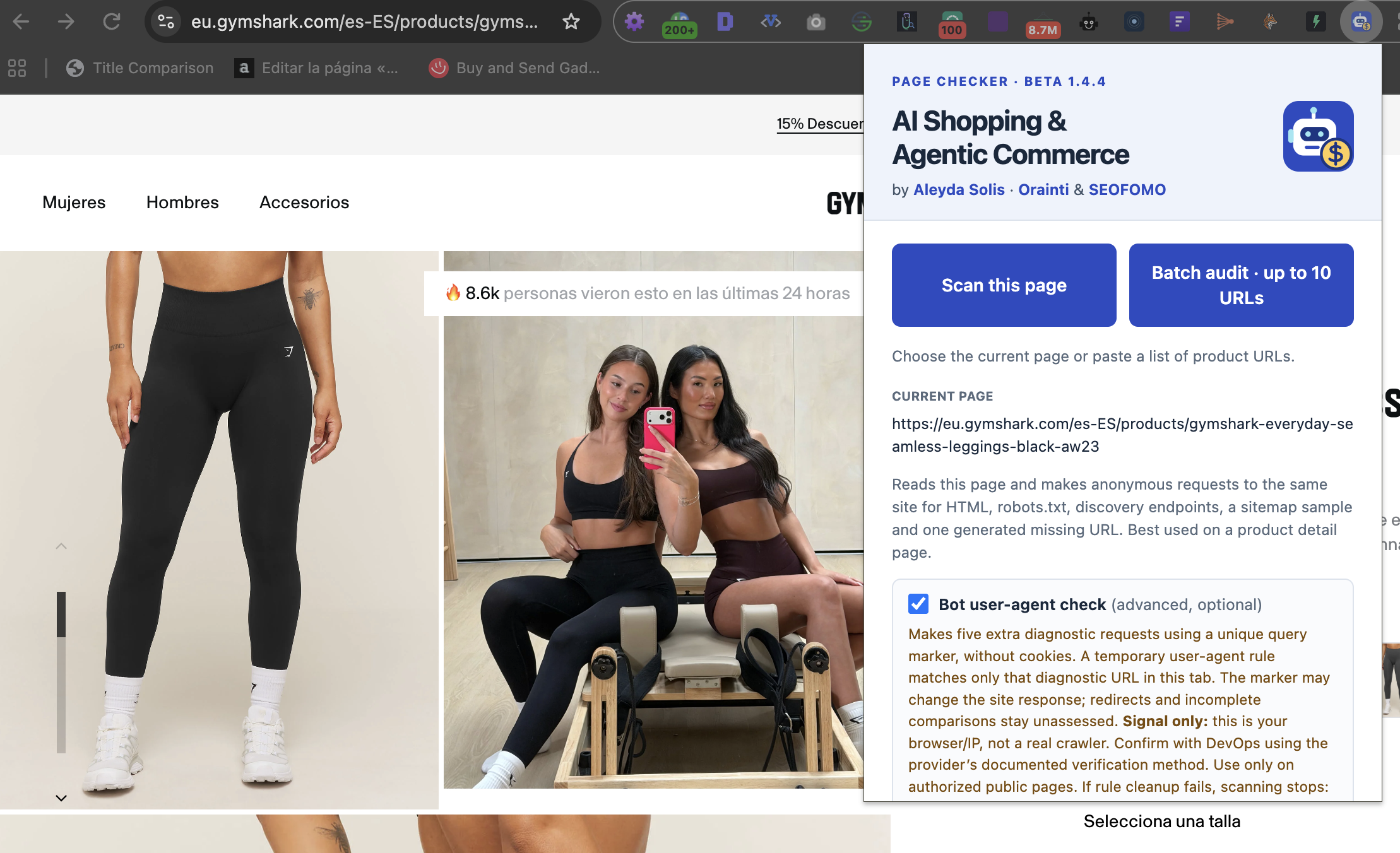
I’ve created the AI Shopping & Agentic Commerce Checker [download the zip to install here], a free Chrome extension that helps you review product-page evidence, compare it with a merchant feed export, and prioritize your next actions.
The extension separates automated validations from manual verifications, so you can see what it has checked and what you still need to confirm.
How to install it
You’ll need Google Chrome on your desktop. No coding, account, or API key is required:
- Download and unzip the Chrome extension ZIP.
- Save the extracted folder somewhere permanent on your computer.
- Enter
chrome://extensionsin Chrome’s address bar. - Enable Developer mode in the top-right corner.
- Click Load unpacked and select the extracted folder containing
manifest.json. - Click Chrome’s puzzle-piece icon and pin AI Shopping & Agentic Commerce Checker — Beta.
Make sure you select the extracted folder containing manifest.json, rather than the ZIP file.
How to check a product page
Open a public ecommerce product page, ideally from a site you manage. Wait for it to load and select the product variant you want to assess.
Then click the extension icon and Scan this page. The report will open with two separate sections:
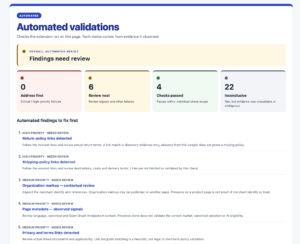
- Automated validations: findings based on the evidence collected from the page and diagnostic requests.
- Manual verifications: checks requiring your input or confirmation through platform accounts, logs, or other systems.
Open each finding to understand what was observed, why it matters, and what to do next.
An Inconclusive result means there wasn’t enough evidence to reach a conclusion. It shouldn’t be interpreted as a pass or a failure.
Go further: compare feed data and check multiple URLs
Compare your merchant feed: Import a feed export in the report, select its format, review the column mapping, and confirm the matching product row. The extension compares the selected row and mapped fields; platform feed acceptance still needs to be checked separately.
Run a batch audit: Select Batch audit, add up to 10 product URLs, and approve access to the relevant websites. Keep the batch workspace open while it runs.
For your first test, leave the optional bot user-agent comparison off. This feature provides diagnostic signals; it doesn’t verify actual crawler access.
What the results tell you
The extension helps you identify product-data issues and gaps in the available evidence. It doesn’t certify AI readiness, predict AI visibility, or validate a complete checkout journey.
You can record a manual override when you’ve verified something yourself. Your decision is shown separately, preserving the original automated result.
Scans, imported feed evidence, and notes stay in your browser. Diagnostic requests go to the websites you scan. Before sharing an exported report, review it for sensitive information.
Give it a go and let me know what you find
Found an unexpected result, a confusing check, or something that could be more useful? I’d love to hear about it.
Please include the extension and Chrome versions, check ID, steps to reproduce the issue, and what you expected versus what happened. A screenshot and public page URL, when shareable, will help too.
If Chrome can’t find the manifest, check that you’ve selected the correct extracted folder. If your work browser blocks installation, contact your administrator.
You can remove the extension at any time from chrome://extensions.
TL;DR
The shift to agentic commerce represents an expansion of ecommerce SEO’s scope, not its replacement. Traditional fundamentals, like quality content, accurate product data, strong brand authority, remain essential. But they now serve dual purposes: guiding human users and enabling AI agents to transact on those users’ behalf.
The brands that understand this shift -and prepare for it now- will show up where decisions are made, not just where clicks used to be.
Stay up to date with the latest SEO and AI search updates by subscribing to the SEOFOMO newsletter for free.


