


What makes a brand consistently show up and get recommended across AI search platforms? After analyzing the patterns, these are the 10 characteristics that AI search winning brands share:
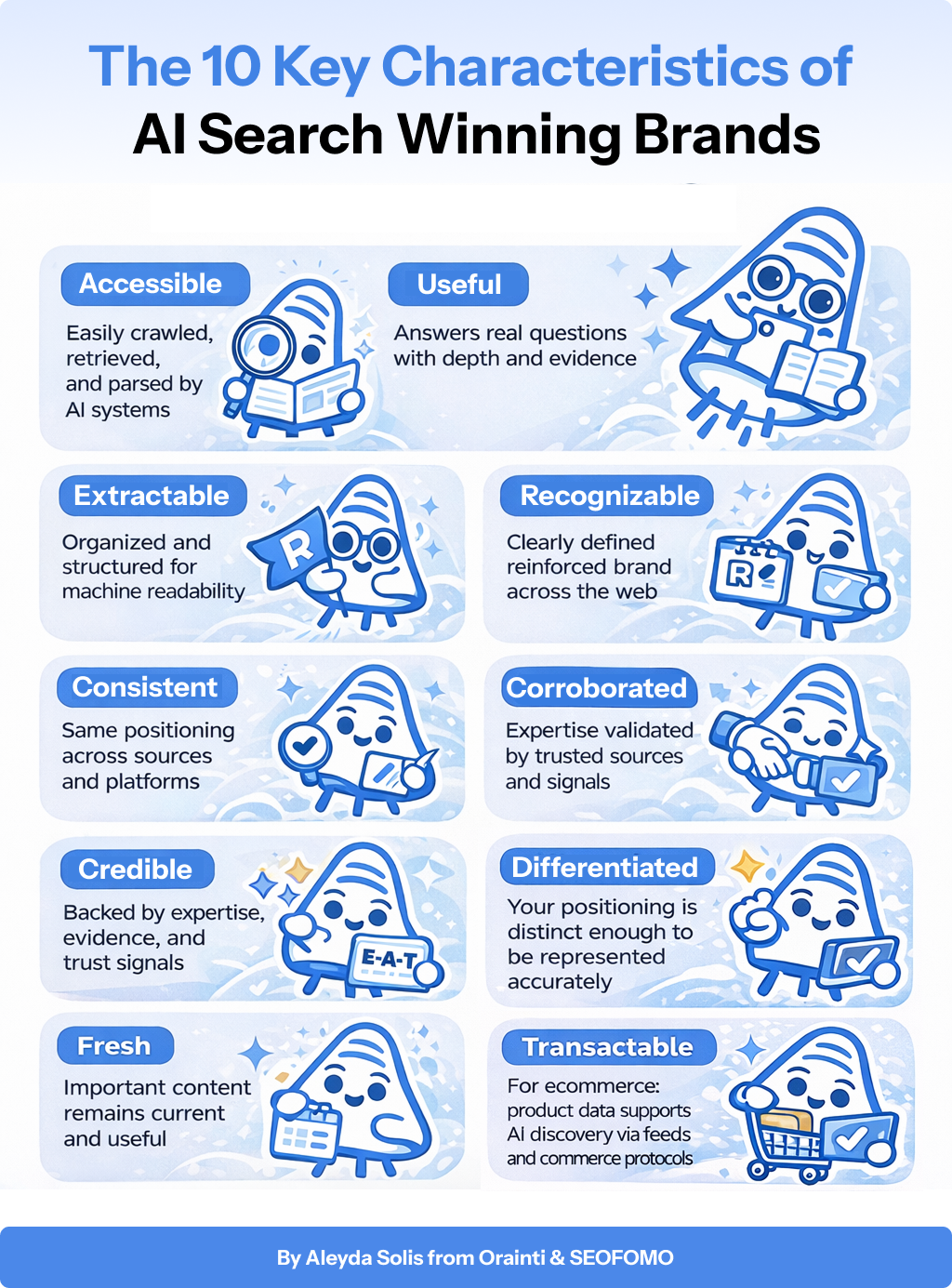
1. Accessible
AI systems can only cite what they can reach. If your content can’t be crawled, retrieved, and parsed by AI platforms, nothing else matters.
This means going beyond traditional crawlability: ensuring content is accessible to both standard crawlers and AI retrieval systems, supporting server-side rendering for JavaScript-heavy sites, and for ecommerce making product data feeds and APIs machine-queryable. Accessibility is the prerequisite for everything else.
2. Useful
AI systems tend to surface content that demonstrates clear utility beyond keyword relevance. Content that gets cited answers real questions with depth, evidence, and expert analysis, not surface-level overviews. Insightful content with citations, statistics, and expert quotes is more likely to achieve visibility in AI-generated responses.
If your content doesn’t add genuine value, it is less likely to be surfaced.
3. Recognizable
Your brand needs to exist as a clearly defined entity that AI models can locate, understand, and distinguish within their semantic systems. This is where entity authority comes in: schema markup, consistent naming across platforms, verified business profiles, and explicit entity relationships.
The stronger and more consistently reinforced your entity is across the web, the more likely AI systems are to identify and represent your brand accurately.
4. Extractable
Your content needs to be organized in ways that machines can reuse, since many AI systems retrieve and process information in chunks. If your key insights are buried, they’re unlikely to be surfaced.
Lead with concise summaries, use clear headings, keep one idea per paragraph, and structure sections so each can stand alone as a self-contained answer. Definition-led sentence structures and self-contained claims are easier for AI systems to isolate and reuse.
5. Consistent
The same positioning, terminology, and brand facts need to appear across all your digital touchpoints: your site, third-party profiles, directories, social platforms, and earned media.
AI systems build confidence through repeated and aligned signals across sources. If your messaging is inconsistent, it becomes harder for systems to reliably associate and recommend your brand. This includes clean schema, Wikidata entries, consistent Crunchbase and LinkedIn profiles, and unified naming conventions everywhere.
6. Corroborated
Independent sources need to validate your expertise and claims.
Structured data helps AI systems understand your entity, but without independent third-party validation from high-authority sources, it is less likely your brand will be surfaced prominently. Repeated references across credible sources strengthen the likelihood of inclusion.
7. Credible
Visibility in AI search is supported by real expertise, evidence, and trust signals, not just claims.
AI systems may incorporate signals such as editorial citations, expert authorship, and overall sentiment reflected across sources. Brands with consistently negative sentiment or weak trust signals may be less likely to be recommended. Publishing original research, proprietary data, and expert analysis creates the citation-worthy assets that build credibility.
8. Differentiated
If your positioning is indistinguishable from competitors, AI systems have fewer signals to select and represent your brand as a distinct recommendation.
Content that introduces original frameworks, proprietary methodologies, and transparent processes, which are harder to replicate across sources, can increase the likelihood of being selected and attributed. The more specific and unique your positioning, the easier it is for AI systems to represent you distinctly.
9. Fresh
Important content needs to remain current and useful. Freshness can play a role in AI citation selection, particularly for time-sensitive or evolving topics, as many systems incorporate retrieval mechanisms that consider recency.
Maintaining a regular update cadence with visible version histories can help sustain relevance. Keep statistics current, update key data points, and signal freshness through clear publication and last-updated dates.
10. Transactable
For ecommerce brands specifically, product data needs to support AI-driven discovery, comparison, and, where supported, purchase flows.
With the emergence of agentic commerce experiences (such as those enabled by structured product feeds and evolving commerce integrations), AI systems are increasingly able to assist in product discovery and evaluation. If your product data is unstructured, delayed, or inconsistent, it becomes harder for these systems to include it in their candidate set.

